Spring & fall
Reading the Ratings, and the Case for a Cold-Climate Model
SEER2 and HSPF2 rate seasonal cooling and heating efficiency, with federal floors of 14.3 and 7.5 for split systems; a cold climate heat pump is also rated to keep working well at 5°F, which most Kentucky homes rarely see.
What do SEER2 and HSPF2 measure?
SEER2 measures how much heat a heat pump removes over a cooling season per watt-hour of electricity, and HSPF2 measures how much heat it delivers over a heating season per watt-hour. ENERGY STAR's key product criteria spell it out: SEER2 is the total heat removed from the house during the annual cooling season, in Btu, divided by the electricity used in watt-hours, and HSPF2 is the total space heating required in "region IV" during the heating season divided by the electricity the system used. Higher is better for both.
The "2" marks the test. DOE's Appendix M1 procedure produces SEER2 and HSPF2, and the older Appendix M produced plain SEER and HSPF, ENERGY STAR notes. Because the tests differ, an old SEER figure on a 2015 unit can't be compared one-for-one with a SEER2 figure on a new one. The heating test points behind HSPF2 and the capacity figures (47°F, 17°F and an optional 5°F) are set out in AHRI Standard 210/240.
A third number, EER2, is the ratio of the rate of cooling delivered to the rate of electricity used, in Btu per watt-hour. None of them shows how a unit behaves at 5°F; that is the job of the cold-climate ratings further on.
What are the federal SEER2 and HSPF2 minimums?
A split-system heat pump made on or after January 1, 2023 must reach at least 14.3 SEER2 and 7.5 HSPF2, under DOE's rule at 10 CFR 430.32. Single-package heat pumps, with everything in one outdoor cabinet, must reach 13.4 SEER2 and 6.7 HSPF2. Those floors apply in every state.
Air conditioners are different, which causes confusion at the counter. The same regulation sets higher cooling-only minimums in the "Southeast," which includes Kentucky and Tennessee, while Ohio, Indiana and West Virginia fall in neither the Southeast nor the Southwest list. A split central AC under 45,000 Btu/h needs 14.3 SEER2 in the Southeast against a 13.4 national floor. For heat pumps there is one national number.
What does the minimum tell you? Only that the unit is legal to make. Rebate programs and ENERGY STAR start above it, so a quote at exactly 14.3 and 7.5 is the floor, not a bad unit, and the replacement page covers the other things a quote should show.
What SEER2 and HSPF2 does ENERGY STAR require?
ENERGY STAR's heat pump specification, Version 6.2 (revised February 2026), requires a split system to reach at least 15.2 SEER2, 11.0 EER2 and 7.8 HSPF2. Single-package units need 15.2 SEER2, 10.0 EER2 and 7.2 HSPF2. Cold-climate certification raises the heating floor to 8.1 HSPF2 for ducted split systems and 8.5 for ductless, and adds tests at 5°F.
Those thresholds show up in rebate rules. Kentucky Power's EnergyAdvantage incentive guide (dated 2025/07) lists $400 when a split or package unit meets 15.2 SEER2 with 7.8 HSPF2, and $500 at 16.2 SEER2, for homes with electric heat and no fuel switching. TVA EnergyRight's tiers are 15 SEER2 for $500 and 17 SEER2 for $800, with the work done by its Quality Contractor Network. East Kentucky Power Cooperative's retrofit rebate for replacing resistance heat lists $750 at the federal minimum and $1,000 at ENERGY STAR levels. Amounts were read 2026-10-29 and can change; the rebates page has the program links.
| Level | SEER2 | EER2 | HSPF2 |
|---|---|---|---|
| Federal minimum (made from 2023) | 14.3 | not set in that rule | 7.5 |
| ENERGY STAR | 15.2 | 11.0 | 7.8 |
| ENERGY STAR Cold Climate, ducted | 15.2 | not read | 8.1 |
| ENERGY STAR Cold Climate, ductless | 15.2 | not read | 8.5 |
Which rating matters more in the Ohio Valley?
In most of the region, HSPF2 matters more, because the heating season is bigger than the cooling season. NOAA's 1991–2020 normals give Louisville about 3,936 heating degree days and 1,742 cooling degree days a year, Cincinnati's airport about 4,892 and 1,160, and Nashville about 3,364 and 1,873. Degree days are a measure of weather, not energy, but they show which season does more work.
There is a catch in the heating number. HSPF2 is figured for one reference climate, Region IV, so it is a fair way to compare two units, not a forecast for your house. Below the low to mid 30s a standard heat pump loses output and the thermostat may bring on strip heat, which runs at a COP of 1.0 (DOE Building America); that part of the bill depends on sizing, the balance point and settings more than on the label.
SEER2 still earns its place. Louisville averages 42.7 days a year at 90°F or hotter, and a muggy July is where a unit's humidity control matters as much as its efficiency. If you're comparing two units with equal HSPF2, the higher SEER2 is the tiebreaker.
In most of the region, HSPF2 matters more, because the heating season is bigger than the cooling season.
What makes a heat pump cold-climate?
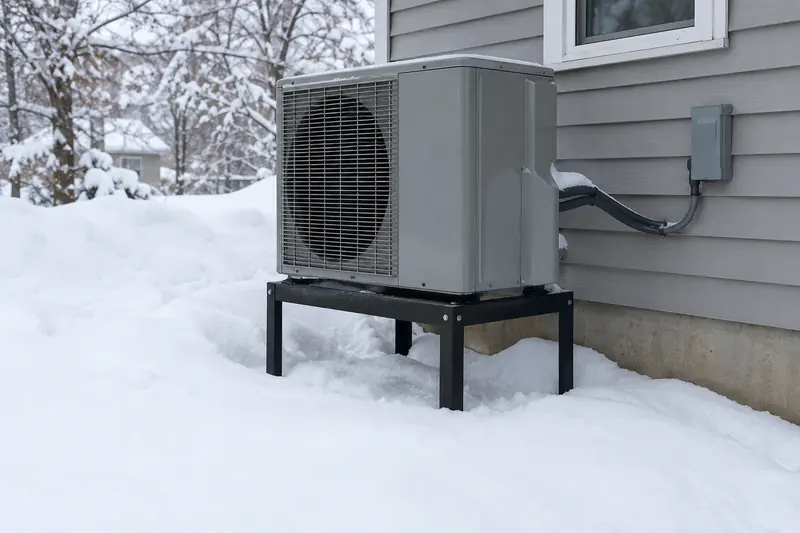
A cold climate heat pump is one built and tested to hold most of its heating output at 5°F and to keep running below that. AHRI's rating standard, AHRI 210/240-2026, defines it as a unit whose compressor cut-out and cut-in temperatures are below 5°F and whose 5°F capacity is at least 70% of its capacity at 47°F.
A standard single-speed heat pump starts losing output in the low to mid 30s: a DOE Building America report puts the steeper drop below about 30°F, and the Building America Solution Center says efficiency falls below about 35°F. That is why an ordinary unit leans on backup heat, and why the balance point for one sized to the cooling load commonly lands in the upper 20s or low 30s, per ORNL.
Cold-climate models push that line down, usually with variable-speed compressors. DOE's federal purchasing program puts it plainly: cold climates require specially designed heat pumps that run at lower outdoor temperatures before switching to resistance heating.
What do the ENERGY STAR and NEEP labels require?
ENERGY STAR's Cold Climate designation sets a 5°F COP minimum of 1.75, enough capacity that 70% of the 47°F output is still there at 5°F, and a controls verification procedure that confirms the unit's own controls reach those numbers as they would in a customer's home. It also raises the heating rating: at least 8.1 HSPF2 for ducted split systems and 8.5 HSPF2 for ductless, against 7.8 HSPF2 for an ordinary ENERGY STAR split heat pump. The opening sections above explain what those numbers measure.
NEEP, a regional efficiency group, publishes a cold-climate specification and product list that utility programs use as a minimum for rebates. Its Version 4.0, in effect since January 1, 2023, asks for a 5°F COP of 1.75 or better at maximum capacity, and NEEP says it was written for IECC climate zone 4 and colder. That puts all of Kentucky inside its target area. NEEP sets no 70% capacity rule; that one belongs to ENERGY STAR, and NEEP lists Version 5.0 as coming soon.
What does that COP floor of 1.75 mean for the label in plain terms? At 5°F the unit puts out 1.75 kWh worth of heat per kWh it draws; strip heat manages exactly 1.0. ENERGY STAR adds that a cold-climate unit keeps working below 5°F, but pairing it with a backup source heats most efficiently when it gets colder still.
How often does the region reach 5°F?
Not often. NOAA's 1991–2020 normals count nights at or below 10°F and at or below 0°F, and 5°F sits between those lines: Louisville's airport averages 4.1 nights a year at or below 10°F and 0.5 at or below 0°F. Cincinnati's airport, in Boone County, is the coldest of the region's big stations: 9.5 nights at or below 10°F and 2.5 subzero nights yearly.
Design data agrees. The NOAA/Air Force engineering weather data for 1988–2017 put the 99.6% winter value at 10°F for Louisville, 9°F for Lexington and 5°F for Cincinnati; by definition, the temperature sits at or below those values for only about 0.4% of the year's hours. A contractor's Manual J uses ACCA's own table, which can differ.
Winter Storm Elliott took Louisville and Lexington to -5°F and Cincinnati to -8°F on December 23, 2022, per NCEI daily data, and the region's records sit far lower: -22°F at Louisville and -37°F at Shelbyville on January 19, 1994. The cold snap plan covers those nights, whatever the equipment.
| Station | Nights at or below 10°F | Nights at or below 0°F | 99.6% winter design value (NOAA/Air Force, 1988–2017) |
|---|---|---|---|
| Cincinnati airport | 9.5 | 2.5 | 5°F |
| Lexington | 7.0 | 0.9 | 9°F |
| Evansville | 6.1 | 1.0 | not read |
| Charleston WV | 5.2 | 0.6 | not read |
| Paducah | 4.6 | 0.5 | not read |
| Louisville | 4.1 | 0.5 | 10°F |
| Nashville | 1.8 | 0.1 | not read |
Who benefits most from a cold-climate model?
Homes that heat with electric resistance get the most from a cold climate heat pump, because every hour the compressor carries the house instead of strip heat is an hour at a COP above 1.0. DOE's 2022 Energy Saver Guide says heat pumps can cut electricity for heating by about 50% against electric furnaces or baseboard; the Solution Center says 30% or more. A unit that keeps output at 5°F keeps more of those hours.
Geography matters next. On the 2015 Building America county map, Ohio has 79 counties in cold zone 5A and Indiana 62, and West Virginia's mountain counties are 5A too, while every Kentucky county is mixed-humid 4A. A house near Dayton or in the West Virginia highlands sees more cold hours than one in Paducah or Nashville; the mixed-humid climate page maps the difference.
A third group is anyone tired of the "Aux" light. If the thermostat calls aux heat on most January mornings, a unit that holds 70% of its capacity at 5°F will call it less. Homes already set up as dual fuel have less to gain, since the furnace already covers the coldest hours. Where a gas or propane furnace is part of the system, CPSC's rules apply: carbon monoxide alarms on every level and outside sleeping areas, with batteries or battery backup and interconnected if possible, and a professional inspection of the heating system each year (per CPSC). If an alarm sounds, get everyone outside, then call 911.
A cold-climate badge does not rescue a unit picked by square footage, so ask for a Manual J load calculation either way.
Do co-op rebates require a cold climate heat pump?
Some Kentucky co-op rebates pay more for one, and the extra money is tied to the ENERGY STAR cold-climate listing, not to the brochure. East Kentucky Power Cooperative's energy-efficiency page lists $1,000 through participating co-ops for an ENERGY STAR certified cold-climate heat pump, against $500 for a standard heat-pump-to-heat-pump upgrade, for electrically heated homes. South Kentucky RECC's page says the unit must be listed as Cold Climate in the ENERGY STAR directory, and Owen Electric lists the same $1,000 tier. Amounts vary by co-op, so check yours.
Other programs in the region are built on SEER2 tiers instead. TVA EnergyRight pays $500 at 15 SEER2 and $800 at 17 SEER2 through a Quality Contractor Network installer, and LG&E and KU list $400 for an ENERGY STAR air-source heat pump on residential rates. All figures are as of 2026-10-29 and subject to change; the rebates page keeps the details. Federal tax credits are no help here: the IRS says 25C does not apply to equipment placed in service after December 31, 2025.
A cold-climate unit has refrigerant-filled lines like any other, and only EPA Section 608 certified technicians may handle that refrigerant. If you're unsure, call a licensed technician.
Some Kentucky co-op rebates pay more for one, and the extra money is tied to the ENERGY STAR cold-climate listing, not to the brochure.
Do higher SEER2 and HSPF2 ratings pay back?
They can, but the size of the saving depends on your house and your rate, so no single payback number holds for the region. The ratings are Btu per watt-hour, which makes the arithmetic simple: every 1,000,000 Btu of seasonal heat takes about 133 kWh at 7.5 HSPF2 and about 118 kWh at 8.5. At Kentucky's August 2026 average of 13.80 cents per kWh (EIA), that is roughly $18.40 against $16.24 per million Btu, on the rating's own terms.
Cooling works the same way: removing 1,000,000 Btu takes about 70 kWh at 14.3 SEER2 and about 59 kWh at 17. Multiply by your own seasonal load and your own rate, from your bill, and compare that difference with the price gap between the two quotes. Ohio's August average was 19.38 cents and Indiana's 17.02, so the same rating gap is worth more there.
Installation can erase the gain. An ENERGY STAR guide warns that improper installation can reduce efficiency by up to 30 percent, more than the gap between most rating tiers. A careful load calculation, duct check and startup, covered on the feature on replacing and hiring, protect whatever rating you pay for.
Loose ends
Smaller questions readers ask about this subject, answered briefly.
Is 15.2 SEER2 the same as 16 SEER?
They come from different test procedures, Appendix M1 and Appendix M, so ENERGY STAR treats them as different numbers. Compare SEER2 only with SEER2.
What is a good HSPF2 for Kentucky?
The federal floor is 7.5 and ENERGY STAR starts at 7.8 for split systems; many rebates use 7.8 as their line. Higher saves more electricity in heating, on the rating's terms.
Is a cold-climate heat pump worth it in Louisville?
Louisville averages 0.5 subzero nights a year under NOAA 1991–2020 normals, so the deepest-cold hours are few. The case is stronger if the house now heats with baseboard or an electric furnace, or if a co-op pays the $1,000 cold-climate tier.
Does a cold-climate heat pump still need backup heat?
Usually yes. ENERGY STAR says these units keep running below 5°F but that pairing with a backup source heats most efficiently when it is colder still. The backup should run less often than with a standard unit.
How can you tell if a model is certified cold climate?
Look it up by model number in the ENERGY STAR product finder or on NEEP's product list rather than trusting a sales sheet. South Kentucky RECC's rebate page asks for the ENERGY STAR directory listing specifically.
Is a ductless mini-split a cold-climate heat pump?
Some are and some are not; the label belongs to the model, not the style. ENERGY STAR's cold-climate floor for ductless split systems is 8.5 HSPF2, higher than the 8.1 for ducted.