Spring & fall
Ducted or Ductless?
Ducted vs ductless mostly depends on the ducts you already have: sound, sealed ducts favor a central heat pump, while homes without ducts, additions and rooms the ducts never reach often favor mini-splits.
What is the difference between ducted and ductless?
The difference is how the conditioned air reaches each room. PNNL's ductless heat pump guide explains that a ducted system has one central air handler, usually in an attic, crawlspace, basement, garage or closet, blowing air through ducts to registers in every room. A ductless system has no central air handler or ducts; small indoor units, often called heads, hang on a wall or sit in the ceiling of the space they serve.
Both kinds use the same outdoor equipment idea. Refrigerant lines carry heat between the outdoor unit and the indoor coil or heads, and both reverse in winter. The how a heat pump works page covers that cycle.
A third option sits between them. PNNL describes ducted mini-splits: compact air handlers, sometimes placed in a conditioned attic, that feed short duct runs to a few nearby rooms.
When do existing ducts make sense for a ducted heat pump?
Existing ducts make sense when they are sound, sealed and mostly inside the insulated part of the house. ENERGY STAR's ductless page puts it simply: if your home has existing ductwork, a ducted air-source heat pump may be the right system. Its air-source heat pump page adds that, in most zones, one can go in as a drop-in replacement when an old central air conditioner needs replacing.
The catch is where the ducts run. PNNL says ducted systems avoid duct losses when the air handler and every duct sit inside the thermal boundary, meaning the insulated walls, floors and ceilings. In plenty of houses they run through a vented attic or crawlspace instead.
So before reusing ducts, ask for a duct leakage test. ENERGY STAR's quality installation page asks contractors to inspect the duct system, test it for leakage and make repairs, and notes that leaky ducts reduce airflow as well as wasting energy.
How much do leaky ducts cost you?
Leaky or exposed ducts can waste a large share of what the heat pump produces. PNNL says losses related to duct systems can account for more than 30% of heating and cooling energy when ducts sit in unconditioned space, from both air leaks and heat moving through the duct walls.
ENERGY STAR's heating and cooling guide (2009) estimates that in typical houses about 20% of the air moving through the duct system is lost to leaks, holes and poor connections. DOE's Energy Saver Guide (2022) says ducts leaking into an attic or crawl space can add hundreds of dollars a year to heating and cooling bills, and that sealing and insulating them is usually very cost effective.
ENERGY STAR also lists the symptoms: humidity problems, excessive dust, or rooms that never seem comfortable can all point to leaky or poorly insulated ductwork. DOE adds that unsealed return joints draw unconditioned air into the system; in a muggy Ohio Valley July that air is damp, which the humidity control page takes up.
ENERGY STAR also lists the symptoms: humidity problems, excessive dust, or rooms that never seem comfortable can all point to leaky or poorly insulated ductwork.
When does a ductless mini-split win?
A mini-split wins where ducts are missing, impractical or out in the weather. ENERGY STAR lists homes with costly electric heat such as baseboard or wall heaters, older homes with radiators or no ducts, additions and outbuildings, rooms over a garage, and hot or cold spots such as home offices.
Efficiency is part of the pull. ENERGY STAR says certified mini-splits use up to 60% less energy than standard electric radiators, and PNNL says ductless systems generally have higher heating and cooling efficiencies. Each head runs independently, so a bedroom and a living room can sit at different temperatures.
There are trade-offs. PNNL says ductless systems generally dehumidify less in cooling mode and filter less air, often with washable mesh filters meant to be cleaned about every two weeks. Even the smallest head may be too big for a small room, and rooms without a head can be uncomfortable; PNNL mentions small transfer fans as one fix. ENERGY STAR adds that heat cannot move through a closed door.
Can you mix ducted and ductless?
Yes, and mixed setups are common in retrofits. PNNL says one outdoor unit can serve a single ductless head, a single ducted air handler, several of either, or any combination. It also describes renovations that add ductless heads to the main living areas while an older central system stays in place for supplemental heat or cooling.
Two cautions from the same guide. On a multi-split, set every head to the same mode, heating or cooling, or efficiency can drop sharply. And turning off some heads to save money can backfire: savings range from modest to negative if the remaining load falls below the outdoor unit's minimum output and it starts cycling. If some rooms will often sit idle, PNNL suggests a second outdoor unit for them.
Sizing still applies to every piece. ENERGY STAR says the contractor should verify the size with a Manual J, and PNNL says each head should match its space's load; the sizing feature explains the calculation.
What does a mini-split install involve?
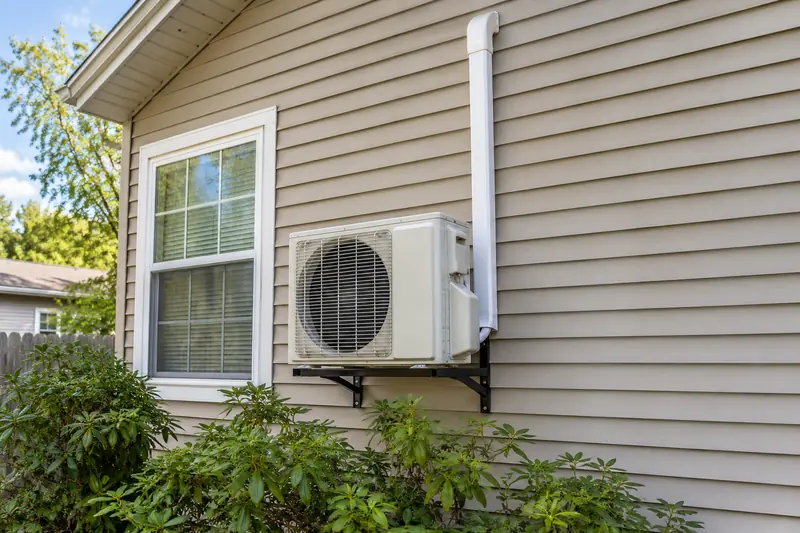
A mini-split install is licensed, certified work, not a weekend project. PNNL lists the pieces: indoor units, outdoor units, refrigerant lines, condensate piping, electrical wiring and controls. Refrigerant handling falls under EPA Section 608, and PNNL notes refrigerant charging must be done by an EPA-certified technician. If you're unsure, call a licensed technician.
A supply house lists mini-split systems (PlumbingSupplyAndMore, shares owners with Heat Pump Weather), which shows what a contractor would be fitting; installation needs a licensed contractor with EPA Section 608 certification.
ENERGY STAR's placement tips are worth raising with the installer. Keep the outdoor unit away from doors and windows, because it releases water during winter defrost that can freeze into icy patches, and check where roof runoff lands. Rebates for both kinds are on the rebates page.
| Factor | Ducted heat pump | Ductless mini-split | Ducted mini-split |
|---|---|---|---|
| Air delivery | Central air handler and ducts | Heads in each served room | Compact air handler, short ducts |
| Duct losses | Over 30% if ducts are outside | None | Low if ducts stay inside |
| Dehumidification | Usually better | Often weaker | Depends on model |
| Filtration | Central filter | Mesh filters, light capture | Filter at the air handler |
| Zoning | One zone unless added | Each head separately | A few rooms per unit |
Loose ends
Smaller questions readers ask about this subject, answered briefly.
Can a mini-split heat a whole Kentucky house?
It can, usually with several heads. PNNL says ductless systems can serve an entire house through a multi-split arrangement, and ENERGY STAR lists whole-home use among its applications.
Are mini-split heads noisy?
None of the sources read here gives a decibel figure. PNNL lists noise ratings among the things to compare when choosing a model, so ask for the spec sheet.
How often should the heads be deep cleaned?
PNNL recommends a deep cleaning of wall-hung heads every 1 to 3 years, more often in humid conditions. That cleaning is a technician's job; the mesh filters are yours.
Will ductless help a hot bonus room over the garage?
That is one of ENERGY STAR's listed uses: spaces next to unconditioned areas where ducts would be exposed to harsher temperatures.
Can I keep my old ducts for just part of the house?
Yes. A mixed system can keep a ducted air handler for the main floor and add heads elsewhere, all on one outdoor unit if the model allows, PNNL says.
Do ductless systems need backup heat?
PNNL notes that many ductless models now heat reliably at very cold temperatures. Whether backup is needed comes out of the load calculation and the model's cold-weather data.