All year
How a Heat Pump Works
A heat pump works by moving heat instead of making it: refrigerant soaks up heat outdoors, a compressor concentrates it, and the indoor coil releases it, with a reversing valve flipping the job for summer cooling.
How does a heat pump move heat?
A heat pump moves heat by running refrigerant in a loop that picks up heat in one place and drops it in another. The DOE Energy Saver Guide (2022) puts it simply: it heats a house by collecting heat from the outside air and concentrating it for use inside, and it works as a central air conditioner in summer by pumping indoor heat outside.
On a 30°F January morning that sounds backwards, but a DOE Building America report (2013) notes that the outdoor coil always runs colder than the outdoor air, so heat still flows from the air into the refrigerant. In heating mode the outdoor coil acts as the evaporator and the indoor coil as the condenser, as Goodman's explainer puts it. The compressor moves the refrigerant along and concentrates the heat, and the indoor coil hands it to the air the blower pushes through your ducts.
An expansion valve then meters the refrigerant back toward the outdoor coil, much as a faucet meters water, and it heads outside to pick up more. The same cycle runs nonstop while the unit is on. PNNL's Building America Solution Center notes it is the same refrigeration technology as your kitchen refrigerator: heat is pulled from one space and dumped in another.
What does the reversing valve do?
The reversing valve switches the direction refrigerant flows, which decides whether the house is being heated or cooled. The Building America Solution Center says this valve is what separates a heat pump from a cooling-only air conditioner: it lets the unit run the cycle in reverse and pull heat from outdoor air in winter.
Goodman's heat pump explainer describes the valve as the part that changes refrigerant flow to set cooling or heating, while a control board decides whether the system should be cooling, heating or defrosting. That third job matters in the Ohio Valley. When frost builds on the outdoor coil, the control flips the valve for a few minutes so the outdoor coil warms up, which is the steam and whoosh explained on the defrost cycle page.
The valve sits inside the sealed refrigerant circuit, so it is never a homeowner repair.
Why is moving heat cheaper than making it?
Moving heat takes less electricity than turning electricity into heat. ENERGY STAR says that because heat pumps move heat rather than converting it from fuel, an air-source unit can deliver up to three times more heat energy than the electrical energy it consumes.
The yardstick is COP, the coefficient of performance. ENERGY STAR's key product criteria define it as heat delivered divided by electricity used, a number with no units. Electric resistance heat, the strips in an air handler or baseboard heaters, has a COP of 1.0 according to a DOE Building America report (2013). That is strip heat's COP, one for one: a unit of heat out for each unit of power in. A heat pump can manage up to 3x the heat out for each unit of power in.
That gap is why a heat pump often cuts the electricity used for heating by about a third to a half compared with baseboard or an electric furnace. DOE's guide puts the reduction at about 50%, and the Building America Solution Center says 30% or more.
The catch is weather. As outdoor air gets colder there is less heat to collect, so both output and COP fall. For standard units that drop gets steep somewhere in the low to mid 30s, which is why the balance point and aux and emergency heat matter so much in a Kentucky January. ENERGY STAR's cold-climate floor for COP at 5°F is 1.75, still well above strip heat's 1.0.
A heat pump can manage up to 3x the heat out for each unit of power in.
What are the parts inside and outside?
Most ducted heat pumps are split systems: an outdoor unit and an indoor unit joined by refrigerant lines, as the Building America Solution Center describes. Each half has its own coil, and the two coils trade jobs when the reversing valve flips.
| Part | Where it sits | What it does |
|---|---|---|
| Compressor | Outdoor unit | Pumps refrigerant and raises its pressure and temperature |
| Outdoor coil and fan | Outdoor unit | Gathers heat from outdoor air in winter, sheds it in summer |
| Reversing valve | Outdoor unit | Sets heating or cooling, and runs defrost |
| Indoor coil and blower | Air handler | Releases heat to house air in winter, pulls heat and moisture out in summer |
| Heat strips | Air handler | Electric backup (auxiliary) heat for cold spells and defrost |
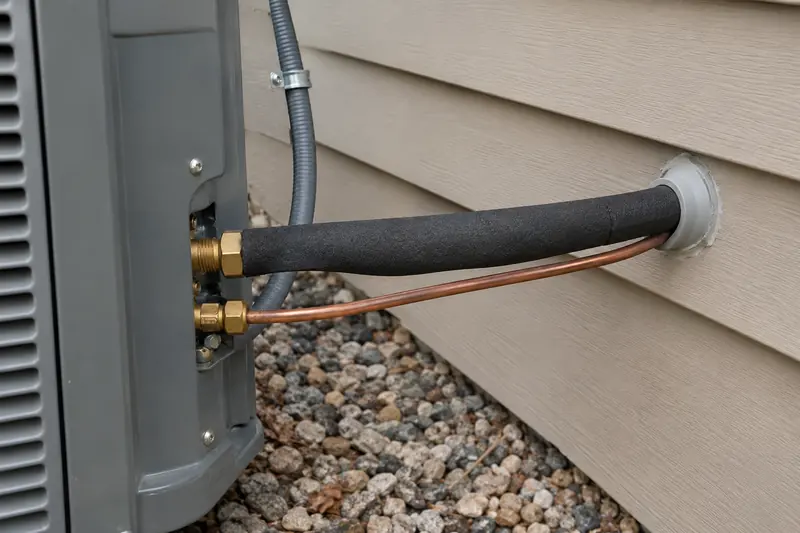
| Line set | Between the units | Insulated copper refrigerant lines |
The copper refrigerant lines between the units are called a line set; a supply house lists line sets by diameter and length (PlumbingSupplyAndMore, shares owners with Heat Pump Weather), which shows what a contractor runs through your wall. Sizing, brazing, pressure testing and charging those lines is work for a technician certified under EPA Section 608, because EPA limits refrigerant purchases to certified technicians.
What runs in the lines is changing. Under EPA's HFC rules, new home systems built from January 1, 2025 need a refrigerant rated at a GWP no higher than 700, such as R-454B or R-32. Older R-410A systems can still be repaired. The replacement page covers what that means when yours wears out. If you're unsure, call a licensed technician.
The thermostat ties it together. A heat pump thermostat controls the compressor and the backup heat separately, which is why thermostat settings affect the bill more than they do with a furnace.
Is a heat pump water heater the same idea?
Yes. A heat pump water heater runs the same move-heat-instead-of-making-it cycle on a tank of water. ENERGY STAR's explanation compares it to a refrigerator working in reverse: instead of pulling heat out of a box, it pulls heat from the surrounding air and moves it into the water.
These units are often sold as hybrid water heaters because they also carry ordinary electric elements and switch to them automatically when demand for heated water runs high. A supply house lists hybrid heat pump water heaters (PlumbingSupplyAndMore, shares owners with Heat Pump Weather) under that name.
ENERGY STAR's heat pump water heater page suggests spaces that stay between 40°F and 90°F year-round with 1,000 cubic feet of air around the tank, and notes the unit can cool and dehumidify the room it sits in, a small bonus in a muggy Ohio Valley basement in July. For the rebates on these, see Kentucky and Ohio rebates.
Loose ends
Smaller questions readers ask about this subject, answered briefly.
Does a heat pump work when it is below freezing?
Yes. Air at 20°F or 30°F still holds heat, and the outdoor coil runs colder than the air so heat flows into the refrigerant. Output and efficiency fall as it gets colder, so many Ohio Valley systems lean on backup heat on the coldest mornings.
Why does the outdoor unit release steam on winter days?
That is usually defrost: the control briefly reverses the cycle to warm the outdoor coil, and melting frost turns to steam. Trane, Lennox and Carrier all describe the steam as normal.
What is a line set?
It is the set of insulated copper refrigerant lines that connects the outdoor and indoor units. Charging the system with refrigerant is work for a technician certified under EPA Section 608.
Does a heat pump burn anything?
No. An air-source heat pump runs on electricity alone. Its backup is usually electric strip heat; a dual fuel system pairs it with a separate gas or propane furnace.
Can a heat pump water heater share the house heat pump?
No. They are separate appliances built on the same idea, and a heat pump water heater carries its own heat pump on its own tank.
Is the whoosh from the outdoor unit a problem?
A soft whoosh when the unit changes modes is the reversing valve at work, and Carrier says there is no need to worry about it. Heavy ice that does not clear in defrost is different, and that calls for a licensed HVAC contractor.