Winter
A Cold Snap Plan for Heat Pump Homes
A heat pump cold snap plan starts before the arctic front: expect strip heat below the balance point, clear the outdoor unit, hold one steady setting, and know what you will do if the grid falters.
How cold do Ohio Valley cold snaps get?
Ohio Valley cold snaps usually bottom out in the single digits, and below-zero nights are rare at most big stations. NOAA's 1991–2020 normals (Cincinnati airport file) count 9.5 nights a year at or below 10°F at Cincinnati, 7.0 at Lexington and 4.1 at Louisville. At or below 0°F, the counts fall to 2.5, 0.9 and 0.5.
The deep extremes are rarer still. Louisville's record low is -22°F on January 19, 1994, the same morning Shelbyville set Kentucky's record of -37°F, per NWS Louisville. Cincinnati's record is -25°F on January 18, 1977.
For planning, the 99.6% winter design temperature in engineering weather data from NOAA and the Air Force (1988–2017) is 10°F at Louisville, 9°F at Lexington and 5°F at Cincinnati; an installer's load calculation may use a different ACCA figure.
What happened during Winter Storm Elliott?
Winter Storm Elliott was the region's sharpest recent test, a drop of about 50 degrees in 12 hours that strained the grid. NWS Louisville's December 2022 summary describes a crash from the 40s on the afternoon of December 22 to subzero readings the next morning and wind chills down to 30 below. NOAA daily data show lows of -5°F at Louisville and Lexington and -8°F at Cincinnati.
On the grid side, the FERC and NERC staff report counts more than 5,400 MW of firm load shed across southeastern grid operators. TVA shed firm load for the first time in its history, over 1,500 MW (about 5% of peak) on December 23 and 10% of peak, over 3,000 MW in total, early on the 24th. LG&E/KU began a 317 MW shed at 5:58 p.m. on December 23, its first ever.
The Kentucky PSC order (January 2025) found that 54,637 LG&E/KU customers lost power, for an average of 59 minutes. It found the utilities' communication lacking and noted that the public appeal to conserve came only after the rolling blackouts had begun. A conservation request may arrive late, so have a plan before the front.
Ohio Valley cold snaps usually bottom out in the single digits, and below-zero nights are rare at most big stations.
What does a heat pump do below 10°F?
Below 10°F, a standard heat pump leans hard on backup heat to hold the setpoint, if its controls let the compressor run at all. A DOE Building America report says standard units lose capacity faster below about 30°F and lean more on supplemental heat, usually electric resistance. Once outdoor air drops under the balance point, which ORNL finds is often in the upper 20s to low 30s when a single-speed unit is sized for cooling, strip heat fills the gap at a COP of 1.0.
Cold-climate models hold on longer: ENERGY STAR's cold climate criteria require a COP of at least 1.75 at 5°F and at least 70% of the 47°F capacity. The cold-climate models page covers the ratings.
Expect the thermostat to show Aux for long stretches; the aux and emergency heat page explains why bills climb then.
How can you prepare the house before a cold snap?
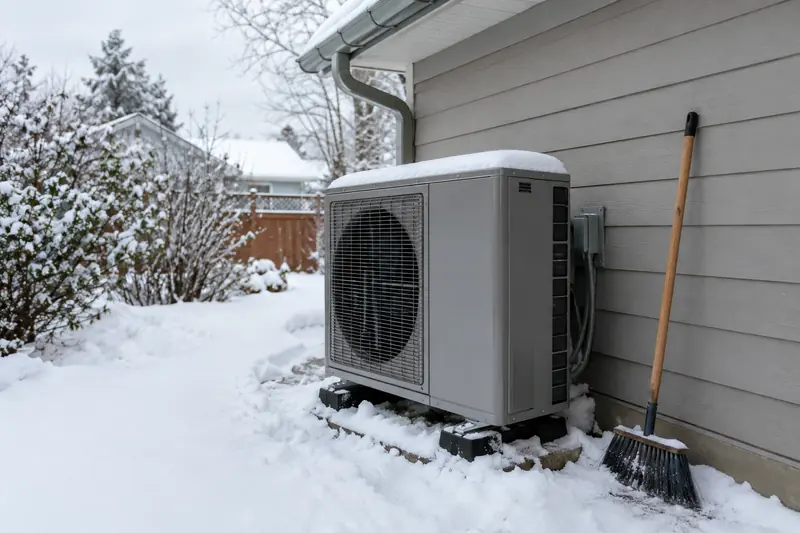
Prepare in the mild days before the front arrives: clear the outdoor unit, check the filter, and set the thermostat where it will stay. At least 2 feet of open space around it is the common homeowner guideline, though the installation manual for your model sets the actual minimums. Fix any gutter that drips onto it; Carrier says that meltwater can refreeze on the coil, and defrost may not be enough to clear a severe freeze-over.
During and after snow, brush light snow off the top with a broom and keep drifts below the louvered panels, as the Lennox EL21KLV manual advises. Makers are blunt about ice: Carrier says never to chip at it, and Lennox says hot water on the unit can crack parts, so don't use it.
Inside, check the filter and leave the thermostat in Heat at one steady setting; DOE's 2022 Energy Saver Guide warns against manual setbacks that bring on resistance heat. If any appliance burns gas or propane, test the CO alarms; CPSC puts one on every level, outside sleeping areas, with battery backup.
What if the power goes out?
When the power goes out, the heat pump and its strip heat stop with it. Ready.gov says not to heat a home with a gas stove or oven because of carbon monoxide. Separately, it suggests disconnecting electronics during an outage, since power can return with surges.
Portable generators are the biggest CO risk in an outage. CPSC's carbon monoxide page says more than 200 people in the U.S. die each year from accidental non-fire CO poisoning tied to consumer products, and more than 100 of those deaths are linked to portable generators. CPSC's May 2026 warning says never to use one inside a home, garage, basement or crawlspace, even with doors or windows open, and to run it outdoors only, at least 20 feet from the house, with the exhaust directed away from windows, doors and vents.
Running a heat pump on a generator needs a licensed electrician to size the generator and connect it. When power comes back after a long outage, check your owner's manual: Lennox's HP29 manual says that after several hours without power, that model should run on Emergency Heat for a six-hour warm-up before returning to Heat.
When should you call for service?
Call a licensed HVAC contractor when ice stays put: thick ice, a unit encased in ice, a fan that stops, ice that does not clear in defrost, or ice on the refrigerant lines. Carrier says frost under about 1/4 inch that clears in defrost is normal. Carrier and Lennox say to turn the heat pump off when ice is heavy and call for service.
Before calling, check the simple things the Lennox EL21KLV manual lists: thermostat mode, the outdoor disconnect switch position, tripped breakers, and a clean filter. Don't open panels or touch refrigerant; refrigerant work is for EPA Section 608 certified technicians. If you're unsure, call a licensed technician.
In Kentucky, HVAC contracting requires a master HVAC license under KRS 198B.656. For a sense of how a heating company describes its work, see Central Plumbing HVAC's heating service page (Central Plumbing HVAC, shares owners with Heat Pump Weather); it works in Bucks and Montgomery County, Pennsylvania, not here, so look for a licensed HVAC contractor who works in your own county.
| Station | Nights at or below 20°F | At or below 10°F | At or below 0°F | Elliott low, Dec 23, 2022 |
|---|---|---|---|---|
| Louisville | 18.5 | 4.1 | 0.5 | -5°F |
| Lexington | 26.2 | 7.0 | 0.9 | -5°F |
| Cincinnati (CVG) | 32.2 | 9.5 | 2.5 | -8°F |
| Evansville | 23.9 | 6.1 | 1.0 | -6°F |
| Nashville | 13.7 | 1.8 | 0.1 | -1°F |
Loose ends
Smaller questions readers ask about this subject, answered briefly.
Should I switch to emergency heat when it drops below zero?
No. Goodman says aux heat comes on by itself when needed. EM heat is for a failed outdoor unit until repair, or as your manual directs.
Will my heat pump stop working at 0°F?
That depends on the unit and its setup. Standard units rely more and more on supplemental heat as it gets colder (DOE), and an installer may set a compressor lockout. ENERGY STAR says certified cold climate models continue running below 5°F.
How do I know if my utility is asking customers to conserve?
Watch your utility's own website and alerts. During Elliott, TVA made customer appeals for voluntary load reduction and PJM issued a call for voluntary conservation, per the FERC and NERC report.
Should I set back the thermostat to save power during a cold snap?
A big setback can backfire: recovery on a single-digit morning can call long runs of strip heat. If your utility asks customers to conserve, a modest, steady setting is the gentler choice.
Can I plug the heat pump into a portable generator?
Not on your own. A licensed electrician has to size the generator and connect it, and CPSC says the generator runs outdoors only.
Can I use the oven for heat when the power is out?
No. Ready.gov warns that heating a home with a gas stove or oven raises the risk of carbon monoxide poisoning, fires and burns.