Summer
Muggy Summers: Humidity and the Cooling Settings
Heat pump humidity control works when a right-sized system runs long cycles with the fan on Auto and the mode on Cool, pulling indoor humidity toward EPA's 30 to 50 percent range on a sticky 67-degree dew point afternoon.
How humid does an Ohio Valley summer get?
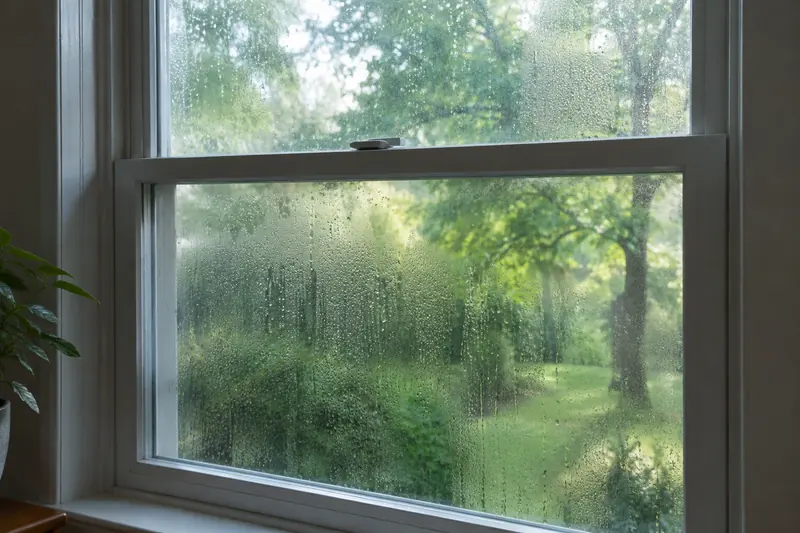
An Ohio Valley summer runs muggy: a normal July afternoon pairs mid-80s heat with a dew point in the mid to upper 60s. For July 15 at 3 p.m., NOAA's 1991–2020 hourly normals (Louisville file) show 86.7°F with a 66.9°F dew point at Louisville, 84.0°F and 66.6°F at Lexington, 83.8°F and 65.6°F at Cincinnati, and 87.4°F and 67.8°F at Nashville.
Mornings feel even heavier. At 6 a.m. on the same date, Louisville's normal is 72.1°F with a 67.1°F dew point, so the air is close to saturated before the sun is high. On 1 day in 10, the afternoon dew point reaches 73 to 74°F at all four stations. Averaged from NOAA hourly normals, Louisville's July dew point is 66.7°F.
Extremes go further. NWS Louisville's 2022 review notes June 13 that year brought dew points in the lower 80s and heat index readings over 110°F. The mixed-humid climate page explains why the region sits in climate zone 4A.
How does a heat pump remove humidity?
A heat pump removes humidity as a side effect of cooling: the indoor coil runs colder than the air's dew point, so water vapor condenses on it and drains away. The Building America Solution Center's ductless guide says these systems automatically remove a certain amount of moisture when cooling under typical conditions.
How much depends on the sensible heat ratio, the share of cooling that goes to lowering temperature rather than wringing out water. BASC says traditional heat pumps and air conditioners run around 0.75, which has historically provided enough dehumidification when the unit is properly sized. Newer, more efficient units tend to have higher ratios and remove less moisture, particularly ductless systems; the ducted vs ductless page weighs that trade.
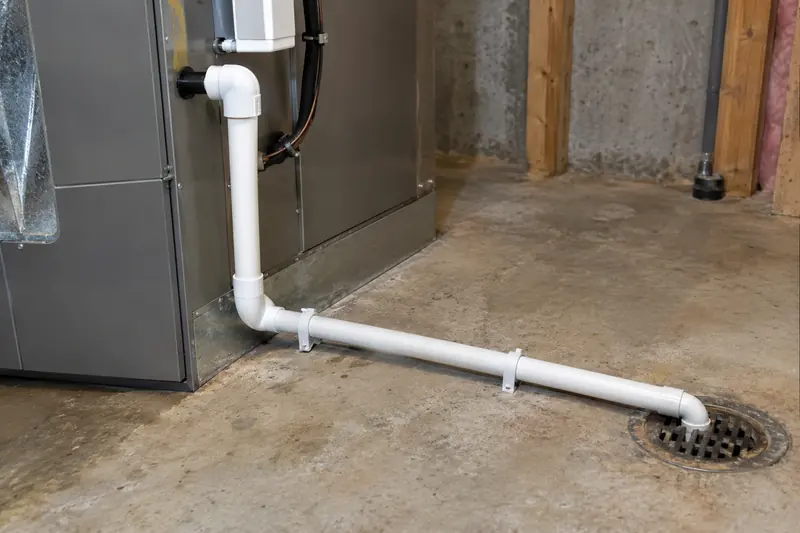
All that water leaves through the condensate drain. ENERGY STAR's maintenance checklist warns that a plugged drain can cause water damage and affect indoor humidity. Lennox's EL21KLV manual suggests checking the indoor drain line monthly and asking your dealer to show you where it is and how to check it.
What indoor humidity should you aim for?
Aim for indoor humidity between 30 and 50 percent, and keep it below 60. That is EPA's guidance in its brief guide to mold and moisture, and ENERGY STAR's dehumidifier page agrees that 30 to 50 percent is generally the optimum, with anything above it able to promote mold growth.
In a Kentucky July that target takes steady work. Air at 75°F indoors holding the moisture of a 67°F dew point outdoors would sit well above 60 percent, so the system has to keep pulling water out all afternoon. A humidity reading from a thermostat or a small indoor gauge tells you whether it is keeping up.
Why can the house feel cool but clammy?
A house feels cool but clammy when the system lowers the temperature without running long enough, or in the right way, to pull out water. Oversizing is the classic cause: ACCA's Manual J verification paper says oversized equipment may degrade humidity control, and BASC says an oversized system cycles on and off more often when cooling and will not provide good humidity control. The sizing feature covers the signs.
The fan setting matters too. BASC's traditional split heat pump guide says to set the fan to Auto rather than On, and to set the unit's time-delay relay to 30 seconds or less in humid climates so moisture on the coil does not evaporate back into the airstream. The relay is an installer setting; the Auto switch is yours.
Airflow is the third suspect. ENERGY STAR's quality installation page lists overly damp air among the results of poor system airflow, alongside higher bills and shorter equipment life. A dirty filter is the part you control; duct and blower problems are for a technician. The settings sections below cover fan Auto, setpoints and Dry mode.
When is a dehumidifier worth adding?
A dehumidifier is worth adding when the heat pump runs properly and readings still sit above about 55 percent through the house, or when one damp area, such as a basement, never dries out. BASC says that in homes where humidity may be an issue, a separate dehumidification system may be needed.
ENERGY STAR describes two kinds. Portable units serve a single room; for a small to medium room that feels damp at 50 to 75 percent humidity, its sizing chart suggests 20 to 30 pints a day. Whole-home units tie into the ductwork, and ENERGY STAR says they carry significant benefits for relatively well sealed homes with central air that see humidity above 55% consistently throughout the house. Certified models use about 20% less energy than similar conventional units.
A whole-home unit is a contractor job: ENERGY STAR says its drain should be routed to a floor drain or condensate pump by an HVAC professional during installation. Supply houses list indoor air quality equipment (PlumbingSupplyAndMore, shares owners with Heat Pump Weather), including dehumidifying units a contractor can add to a system. Wiring, ductwork and the disconnect are not do-it-yourself work. If you're unsure, call a licensed technician.
| Station | Temperature | Dew point | Dew point, 1 day in 10 |
|---|---|---|---|
| Louisville | 86.7°F | 66.9°F | 73.9°F |
| Lexington | 84.0°F | 66.6°F | 73.0°F |
| Cincinnati (CVG) | 83.8°F | 65.6°F | 73.0°F |
| Nashville | 87.4°F | 67.8°F | 73.0°F |
Should the heat pump fan be on Auto or On?
Auto is the right fan setting for summer cooling in this region. DOE's 2022 Energy Saver Guide tells homeowners to set the fan switch to "Auto" unless an indoor air quality professional has set the system up to run continuously for health reasons.
The reason is water. When the compressor stops, the indoor coil is still wet with the moisture it just pulled out of the air. The Building America Solution Center's split heat pump guide warns that in humid climates, moisture on that coil can evaporate back into the air stream and add to indoor humidity, and it recommends "Auto" rather than "On."
On a sticky 70-degree dew point afternoon, "On" can feel like a breeze but leave the house damper by evening. If the house feels stuffy with Auto, the fix is usually airflow or sizing, which the page on oversized heat pumps covers.
What cooling temperature should you set in summer?
Set it as warm as your household finds comfortable while you are home and awake; ENERGY STAR's heating and cooling guide (2009) uses 78°F as its starting point for cooling. DOE's guide says the same thing in words: as high as is comfortable, and mindful of pets left at home.
Muggy air makes a given number feel warmer, which is why a dry 78°F and a damp 78°F are different afternoons. NOAA's 1991–2020 hourly normals put Louisville's mid-July 3 p.m. dew point at 66.9°F, with the 90th percentile for that hour at 73.9°F, per the Louisville hourly normals file. Getting humidity down often lets you live with a warmer setpoint.
Ceiling fans help more than people expect. DOE says a ceiling fan lets you turn the thermostat up about 4°F with no loss in comfort, run counterclockwise in summer.
Muggy air makes a given number feel warmer, which is why a dry 78°F and a damp 78°F are different afternoons.
Why should a heat pump sit in Cool, not Auto mode?
Pick "Cool" in summer and "Heat" in winter, because ENERGY STAR's air-source heat pump page advises avoiding Auto mode so the system does not flip between modes on unseasonably warm or cold days. That matters most in May and September here, when a cool morning can turn into a warm afternoon.
The mode is yours to set; installer menus such as thresholds are not. The winter thermostat page explains those installer settings for the heating side.
DOE says a ceiling fan lets you turn the thermostat up about 4°F with no loss in comfort, run counterclockwise in summer.
What does dry mode do on a mini-split heat pump?
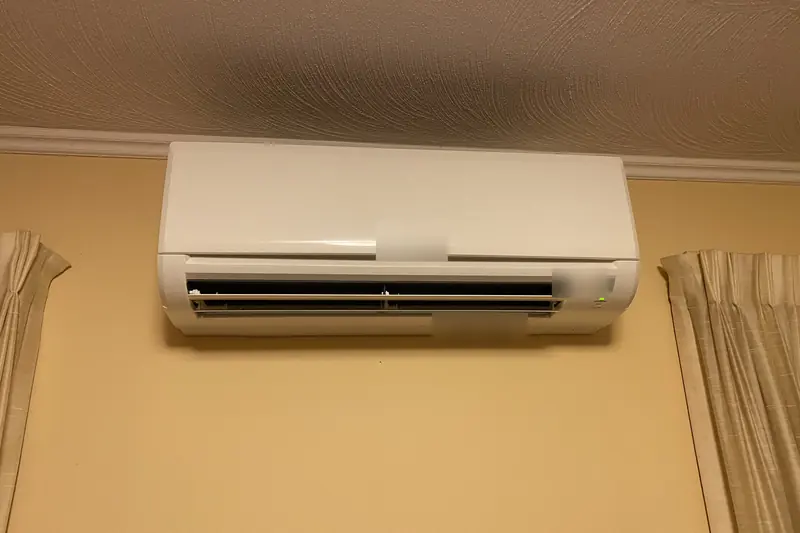
Dry mode runs a ductless system to pull moisture first and cool second. A Lennox mini-split user manual says to use Dry mode in rainy or humid weather to remove the most moisture, that it cannot heat, and that it gives a cooling side effect. The same manual gives 76°F to 79°F as the proper set temperature range for dehumidifying, and a companion controls guide says fan speed cannot be adjusted in Dry mode.
Those numbers belong to one maker's models, so check your own manual before copying them. The Solution Center's ductless heat pump guide describes Dry mode as operation optimized for dehumidification rather than efficient cooling, and says using it can be part of a home's moisture plan.
Wall heads sense temperature near the ceiling, where air is warmest. The same PNNL guide notes the room at head and chest level can end up colder than the setpoint, and that setting the head slightly higher helps. A wall thermostat or a remote with its own sensor, where the model allows one, solves the same problem.
Does turning the heat pump off while you are out save money?
A modest bump up while you are away is reasonable in summer, but switching the system fully off on a muggy day trades a small saving for a damp house. DOE's 2022 guide says to raise the temperature when you are sleeping or away, and ENERGY STAR's 2009 guide suggests 5 to 8 degrees up in summer for a manual thermostat when you are out for several hours.
ENERGY STAR's heat pump page is stricter: it says heat pumps do not save energy by turning down when you are away or asleep and suggests picking a comfortable temperature and leaving it. DOE's warning about heat pump setbacks is about winter, when recovery can call electric strip heat; cooling has no strip heat to trigger. A smart or programmable thermostat built for heat pumps can handle both seasons.
The plain middle ground: raise it a few degrees for a workday, and keep it running. A house shut up in July warms and grows damper all day, and the unit then faces a long catch-up run at the hottest hour.
Loose ends
Smaller questions readers ask about this subject, answered briefly.
Why does my house feel damp even though it is cool?
Usually the system reaches the setpoint before it has run long enough to pull water out, which oversized units do. Fan On instead of Auto and weak airflow can add to it.
Should I run the fan on On to dry the house?
No. BASC recommends Auto, because running the fan after the compressor stops can blow coil moisture back into the house.
Does a ductless heat pump control humidity as well as a ducted one?
BASC calls it a general trend that ductless units remove less moisture in cooling mode. Lennox's mini-split manual says its Dry mode is meant for rainy or humid weather; check your own manual.
What humidity is too low in summer?
EPA's ideal range starts at 30 percent. With July dew points in the mid to upper 60s, the usual summer problem here is the high end.
Is 78°F too warm for sleeping?
Many people sleep better cooler, and DOE's guide leaves the number to your comfort. A ceiling fan in the bedroom is the cheapest way to sleep at a warmer setpoint, since DOE says it is worth about 4°F.
Does running the fan on "On" clean the air better?
It moves more air through the filter, which is why DOE allows it when an air quality professional sets it up. In a humid summer the trade-off is moisture blown back off the wet coil, so most homes do better on Auto.
Should a mini-split stay on Dry mode all summer?
Dry mode is meant for rainy or muggy weather. On a hot, dry afternoon Cool mode handles the heat better, so switch based on the day and your manual's advice.