Winter
The Defrost Cycle, Steam and Ice
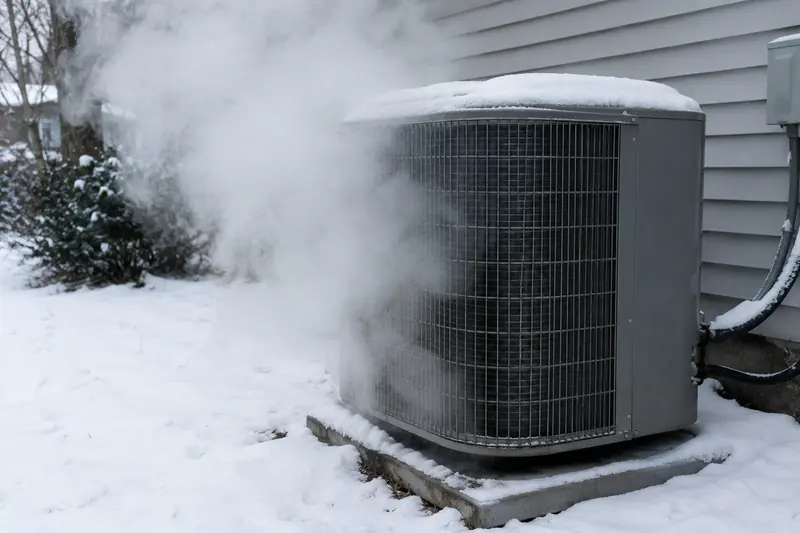
A heat pump defrost cycle briefly reverses the system to melt frost off the outdoor coil; steam, a whoosh and a quiet fan are all normal, and most cycles end within a few minutes, about 15 at the long end.
Why does the outdoor coil frost over?
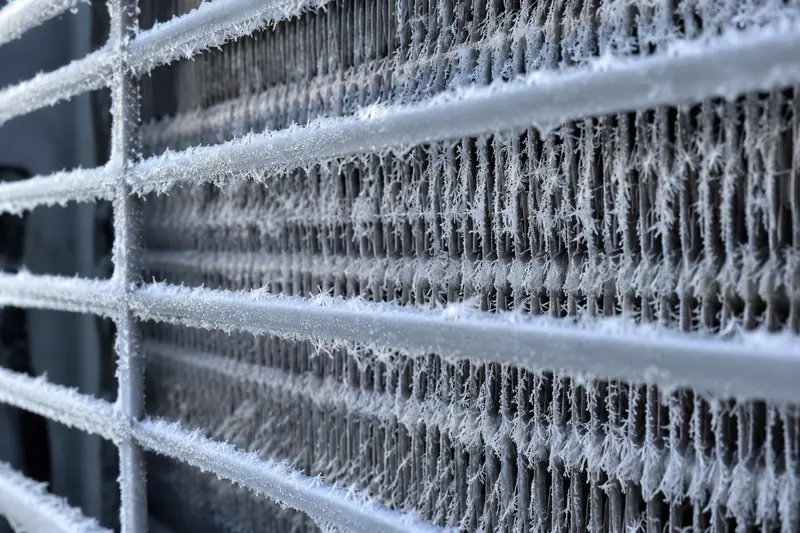
The outdoor coil frosts because in heating mode it runs colder than the outdoor air, so moisture condenses on it and freezes. A DOE Building America report (2013) explains it in two steps: once the coil drops below the air's dew point, water condenses on it, and once the coil is below freezing, that water turns to ice. Left alone, the ice would eventually block airflow through the coil.
The ORNL report (2015) gives a frosting range of roughly 17°F to 42°F outdoors. Above 42°F the coil stays above the frost point; below 17°F the air is usually too dry to build much frost. Lennox's EL21KLV instructions say frost forms below 45°F, and Trane notes the coil typically runs 10–20°F colder than the air, so defrost can start in the low 40s and is more common in the 20s and 30s. In plain terms, frost forms roughly from the mid 40s down to the high teens.
That range is the heart of an Ohio Valley winter. NOAA's 1991–2020 normals put the January mean temperature at 31.4°F at the Cincinnati airport, 35.7°F at Louisville and 39.6°F at Nashville (NOAA monthly normals, Louisville). A raw, damp 35°F day in Lexington is close to ideal frosting weather, so defrost here is routine, not a warning.
What happens during a heat pump defrost cycle?
During defrost, the reversing valve switches the system into cooling mode for a few minutes so hot refrigerant runs through the outdoor coil and melts the frost. Trane describes it as putting the heat pump into the cooling cycle briefly, then returning to heat once the ice is gone.
What you notice outside is the giveaway. Trane says you may see a cloud of steam from the outdoor unit, which is the frost melting and evaporating, hear a swooshing sound as refrigerant reverses, and find the outdoor fan stopped while compressor noise rises or falls. Lennox's defrost page calls the whoosh and the steam normal signs of the process, and Carrier says a gentle whoosh from the reversing valve is nothing to worry about.
Inside, the system tries to hide it. Because the indoor coil is briefly cooling, many systems switch on electric heat strips to keep the supply air warm; ORNL notes resistance heat is typically applied in the air handler during defrost. Trane adds that the thermostat may show "AUX" while this happens. Carrier says a brief spell of cooler air from the vents can be normal. The aux and emergency heat page explains why that backup shows up on your bill.
A raw, damp 35°F day in Lexington is close to ideal frosting weather, so defrost here is routine, not a warning.
How long does a defrost cycle last?
Most defrost cycles wrap up in a few minutes, with roughly 15 as the long end, depending on the maker and the control. Published figures vary: Trane says its demand-defrost cycles usually run 3–5 minutes, Carrier says about 5–10, and Lennox gives 5 to 15 minutes. Lennox adds that most systems check for frost every 30 to 90 minutes during heating.
| Source | Stated length | Note |
|---|---|---|
| Trane | Usually 3–5 minutes | Demand defrost, runs only when needed |
| Carrier | About 5–10 minutes | Varies by system and conditions |
| Lennox (owner page) | 5–15 minutes | Frost checks every 30–90 minutes |
| Lennox EL21KLV manual | 5–15 minutes | At preset intervals |
| Lennox mini-split manual | 5–12 minutes | Ductless model |
How often it happens depends on the air. A dry 20°F night may bring fewer cycles than a wet 34°F morning with freezing drizzle, since the colder air holds less moisture. What matters is the trend: Trane says to call a local HVAC dealer if the unit seems to defrost constantly, or if cycles keep getting longer while ice spreads across the unit.
When is ice on a heat pump a problem?
Ice is a problem when it is thick, keeps growing, or blocks the fan. Carrier draws the line at about 1/4 inch: a thin layer of frost that clears in defrost is normal, while ice thicker than 1/4 inch, a solid coating, or ice that doesn't clear during defrost needs attention. Lennox's frozen heat pump page adds heavy ice covering the whole unit, ice that stops the fan blades from turning, and ice on refrigerant lines inside or outside the house.
Any of those means a call to a licensed HVAC contractor. Carrier and Lennox both say to turn the heat pump off when ice is heavy rather than let it keep running. Switching the thermostat to emergency heat does that while keeping the backup heat on until the repair. Goodman's FAQ says the same: a heavy coating of ice is a reason to contact a licensed professional as soon as possible.
Ice is not something to attack by hand. Lennox warns that using tools on ice can damage the coils, fins and fan blades, and Carrier says never to try freeing the coil that way. Hot water is not a fix either: Lennox says the sudden temperature change can crack components. If you're unsure, call a licensed technician.
What can you do safely about snow and ice?
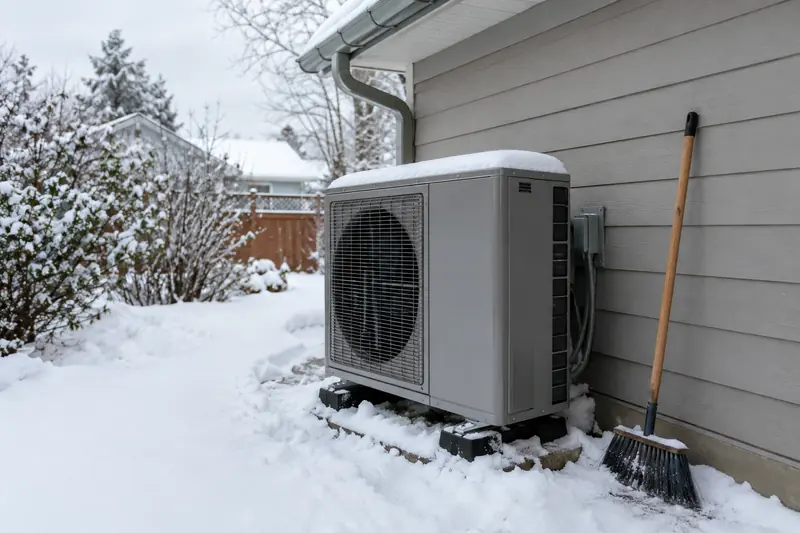
Your part is keeping snow, dripping water and clutter away from the unit; the ice itself belongs to the defrost cycle or a contractor. Lennox's frozen-unit page says to clear snow away after storms without piling it against the sides, and to gently brush light snow from the top with a broom, never a sharp tool. The Lennox EL21KLV manual adds: keep the snow level below the louvered panels.
Watch the roofline. Carrier says water from melting snow can drip onto the coil and refreeze faster than defrost can handle, and the fix is repairing the source, such as a leaky gutter. Lennox says gutters and downspouts shouldn't drain onto or near the heat pump. Keep at least 2 feet of open space around the unit, the common homeowner guideline; the installation manual sets the real minimums, and the EL21KLV manual notes clearances may need increasing where snow or ice falls from above, which is an installer's call.
The maintenance and outdoor unit feature covers the rest of the year, and the cold snap plan covers storms like Winter Storm Elliott. For why output drops in this weather, see heat pumps in cold weather.
Loose ends
Smaller questions readers ask about this subject, answered briefly.
Why is my heat pump smoking in winter?
It is almost always steam. Trane explains that the cloud is frost melting and evaporating during defrost, and it clears within minutes.
Is it normal for the outdoor fan to stop?
Yes, during defrost. Trane notes the outdoor fan may stop while the system runs in reverse, then restart when heating resumes.
Why does cool air come from the vents for a few minutes?
The indoor coil is briefly cooling during defrost. Many systems turn on heat strips to cover it, but Carrier says a short spell of cooler air can be normal; persistent cold air is a reason to call a technician.
What if ice builds up around the base of the unit?
Lennox lists heavy ice covering the unit or blocking airflow as a sign of a problem, so growing ice at the base deserves a contractor's look. Meanwhile keep snow below the louvers and stop gutters from dripping on the unit.
Can I cover my heat pump in winter?
Not while it is heating. The outdoor unit needs open airflow, and Lennox recommends at least two feet of clearance. Ask your installer about a raised stand or a roof overhang if snow falls on it.
Does defrost waste a lot of energy?
It takes some, since the system pauses heating and may run strip heat. Defrost that runs only when frost is present, which Trane calls demand defrost, keeps the cycles shorter.
How do I know defrost is working?
You'll see frost build on the coil and then clear, often with steam and a whoosh, at intervals. A coil that stays solidly white or keeps thickening means defrost is not keeping up.