Winter
How a Heat Pump Copes With Cold Weather
A heat pump in cold weather keeps pulling heat from outdoor air, but its output and efficiency both fall as the air cools, so standard units start leaning on backup heat in the low to mid 30s.
How does a heat pump find heat in cold air?
A heat pump finds heat in cold air by running its outdoor coil colder than the air around it, so heat flows from the 20°F air into the refrigerant. A DOE Building America report (2013) puts it simply: the outdoor coil is always colder than the outdoor air. The compressor then concentrates that heat and sends it indoors.
The Building America Solution Center (PNNL) calls it the refrigerator's cycle, with a reversing valve that runs it backward in winter.
The ratio of heat delivered to electricity used is the coefficient of performance, or COP, a number with no units (ENERGY STAR criteria). Electric strip heat has a COP of 1.0, which is why a heat pump often cuts the electricity used for heating by about a third to a half compared with baseboard or an electric furnace, by the estimates of DOE's 2022 Energy Saver Guide (about 50%) and BASC (30% or more).
- Heat pump carries the house alonedown to the balance point
- Frost and defrost cyclesmid 40s down to the high teens
- Balance point zoneupper 20s to low 30s, standard units
- Backup heat carries morebelow the balance point
- Cold-climate rating pointrated at 5°F
Why does a heat pump lose output and efficiency in the cold?
Heating output and COP both drop as the outdoor air gets colder, and the house needs more heat at exactly the same moment. The Building America report found that standard heat pumps more rapidly lose capacity once it drops below about +30°F and then lean harder on supplemental heat, usually an electric resistance heater. BASC says their heating efficiency falls below about 35°F. Heat Pump Weather's reading of the two: for standard units the slide steepens in the low to mid 30s, and no single temperature fits every model.
One lab measurement shows the size of it. An ORNL report (2015) describes a test unit whose net heating capacity at 35°F, with frost and defrost counted, was 30% below its rated capacity at 47°F. One unit, not a rule, but it shows why November and January feel so different.
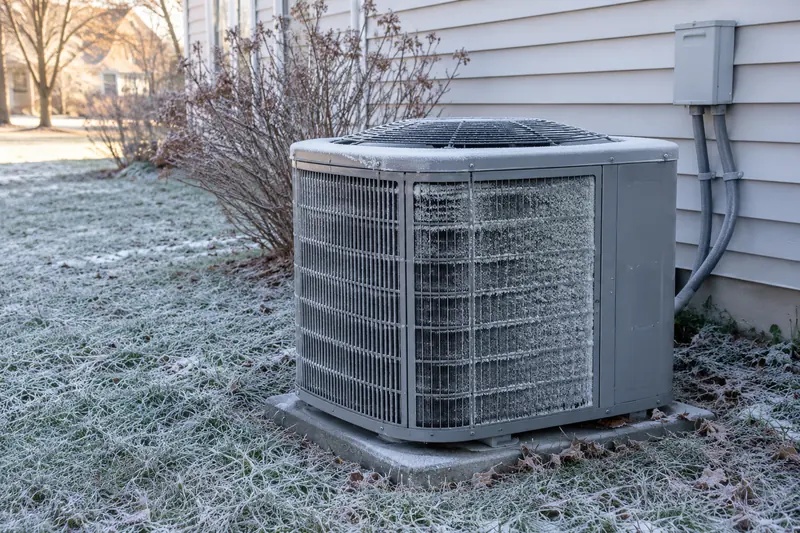
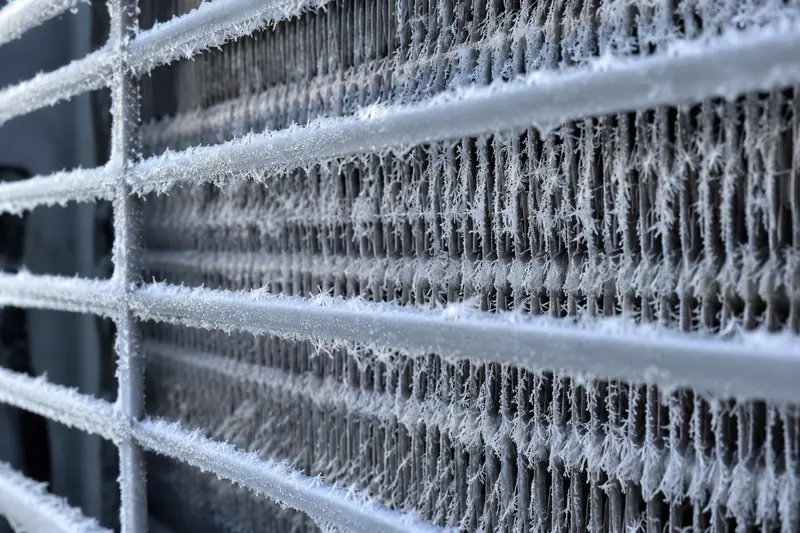
Frost takes its own share. Between roughly the high teens and the mid 40s, moisture freezes on the outdoor coil and the unit must pause to melt it; the defrost cycle page covers the steam, the whoosh and the short pause in heating.
What do the 47°F, 17°F and 5°F ratings tell you?
The three temperatures are AHRI's heating test points, and together they show how fast a given model loses output as the air cools. AHRI Standard 210/240-2026 measures full heating capacity at 47°F outdoors (the rated heating capacity test point) and at 17°F (the low-temperature test point), with 70°F indoors. The 5°F test is the cold-climate test point: optional for ordinary heat pumps, required for any unit certified as cold climate.
AHRI calls a heat pump cold climate when its 5°F capacity is at least 70% of its 47°F capacity and its compressor is set to keep running below 5°F. ENERGY STAR's Cold Climate designation (spec version 6.2) adds a minimum COP at 5°F of 1.75 and a controls check to confirm the unit hits those numbers on its own controls. A COP of 1.75 means 75% more heat per kilowatt-hour than strip heat, even at 5°F.
When comparing models, ask the contractor for the maker's expanded performance data at 17°F and 5°F, not only the headline rating. The cold-climate models page weighs whether a Kentucky house needs one, and the ratings and cold-climate feature decodes SEER2 and HSPF2.
How often is Ohio Valley weather that cold?
Freezing nights are routine here; below-zero nights are not. NOAA's 1991–2020 normals give Louisville 74 nights each year that reach 32°F or colder, 18.5 that reach 20°F and 0.5 that reach 0°F (NOAA normals, Louisville). The Cincinnati airport station, the coldest of the region's big stations, averages 99.8, 32.2 and 2.5.
| Station | 32°F or below | 20°F or below | 10°F or below | 0°F or below |
|---|---|---|---|---|
| Louisville | 74.0 | 18.5 | 4.1 | 0.5 |
| Lexington | 89.9 | 26.2 | 7.0 | 0.9 |
| Cincinnati (CVG) | 99.8 | 32.2 | 9.5 | 2.5 |
| Charleston WV | 94.3 | 22.6 | 5.2 | 0.6 |
| Nashville | 66.3 | 13.7 | 1.8 | 0.1 |
Most winter nights here fall between the 47°F and 17°F test points, and the 5°F test describes a night Louisville sees about once every two years on average. DOE's FEMP program says heat pumps work well in mixed climates; the home page maps the region's winter normals.
The extremes still arrive. Louisville's all-time low is -22°F, set on January 19, 1994 (NWS Louisville), and Winter Storm Elliott took Louisville and Lexington to -5°F and Cincinnati to -8°F on December 23, 2022. For sizing, NOAA/Air Force engineering weather data for 1988–2017 put Louisville's design temperatures at 16°F (99.0%) and 10°F (99.6%); a contractor's Manual J uses ACCA's own table, which may differ. The cold snap plan covers nights like Elliott.
Most winter nights here fall between the 47°F and 17°F test points, and the 5°F test describes a night Louisville sees about once every two years on average.
What is normal for a heat pump on a 20°F morning?
On a 20°F morning, a standard heat pump that runs for long stretches, frosts over, defrosts and calls on backup heat is doing its job. That temperature sits inside the 17°F to 42°F band where ORNL says outdoor coils frost, and below the 26°F to 32°F range ORNL calls typical balance points for single-speed units sized for summer cooling. The balance point and backup heat feature explains why backup heat is expected below that line.
The coil frosts and clears every so often, sometimes with steam, a whoosh and the outdoor fan going quiet, all normal per Trane. The thermostat may read "Aux Heat On," which Honeywell Home says means backup heat is helping the compressor. And the outdoor unit may run almost nonstop, since below its balance point it cannot carry the load by itself.
None of this calls for a switch to emergency heat. Goodman's heat pump FAQ says there is no need to flip it on just because it is below freezing; auxiliary heat comes on by itself when the heat pump needs help. The aux and emergency heat page explains the difference, and winter thermostat settings covers why a steady setpoint usually beats a deep overnight setback.
When is cold-weather heat pump behavior a problem?
It becomes a problem when ice stays, the fan stops, or the house keeps losing ground. Carrier calls a thin layer of frost, generally under 1/4 inch, normal, and calls thicker ice, a solid coating or ice that will not clear in defrost not normal. Lennox adds ice that blocks the fan blades, ice covering the whole unit and ice on the refrigerant lines. Any of those means a call to a licensed HVAC contractor.
Persistent cold air at the vents is another sign, Carrier says, and Trane flags a unit that defrosts constantly with ever longer cycles.
A few checks are yours before you call. Confirm the thermostat is in Heat with a sensible setpoint, the disconnect switch by the outdoor unit is on, no circuit breaker has tripped, and the filter is clean; that is the pre-service list in the Lennox EL21KLV manual. Leave the panels closed. If the outdoor unit has failed, emergency heat is the temporary setting that runs the backup alone until it is repaired. If you're unsure, call a licensed technician.
Loose ends
Smaller questions readers ask about this subject, answered briefly.
Does a heat pump still heat when it is below freezing?
Yes. It keeps moving heat from outdoor air, just less of it, and the auxiliary heat fills the gap automatically when the heat pump cannot keep up, as Goodman's FAQ describes. ENERGY STAR notes that cold-climate units keep working below 5°F.
Is it normal for a heat pump to run all morning in January?
Often, yes. Below its balance point a heat pump cannot meet the house's heat loss alone, so it runs long cycles while backup heat helps.
How cold is too cold for a standard heat pump?
There is no single cutoff. Standard units lose capacity faster in the low to mid 30s and rely more on backup heat as it gets colder; how much depends on the model's 17°F and 5°F data and on the house.
Where can I find my heat pump's 17°F and 5°F output?
The maker's expanded performance data lists it; an installer can look it up from the model numbers. The 5°F figure may be missing on models not certified as cold climate, since that test is optional for them.
Do heat pumps make sense in Kentucky winters?
FEMP says heat pumps work well in mixed climates, and DOE Building America's 2015 county map puts all of Kentucky in mixed-humid zone 4A.
Should I switch to emergency heat when a cold front comes through?
No. Goodman says there is no need to turn on emergency or auxiliary heat just because it is below freezing. Emergency heat shuts the compressor off and runs only the backup, which usually costs more.