Winter
Below the Balance Point: Aux Heat and Emergency Heat
Below a heat pump's balance point, the upper 20s to low 30s for typical single-speed units, the thermostat adds aux heat automatically; emergency heat is a manual setting that shuts the heat pump off and runs only the backup.
What is the heat pump balance point?
The balance point marks the outdoor temperature at which a heat pump's output just matches the heat the house loses; any colder, and the heat pump alone falls short. ORNL's definition is the temperature "below which the heat pump is no longer able to meet the required heating load." Picture two lines on a chart: the house's heat need climbing as the air cools, the heat pump's output sliding down. Where they cross is the balance point.
The Building America Solution Center (BASC) adds the practical half: below the balance point, the heat pump cannot fully heat the home without a backup source. In most Ohio Valley houses that backup is electric strip heat in the air handler, shown as "aux" on the thermostat.
For a number, the ORNL report (2015) calls 26°F to 32°F the more typical range when single-speed units are sized from the design cooling load, standard industry practice. So for standard single-speed units sized for cooling, expect a balance point from the upper 20s into the low 30s; variable-speed and cold-climate units can push it lower. It is a property of a house and its equipment, not a target or a thermostat setting.
What sets a house's balance point?
Two things set it: how fast the house loses heat, and how much heat the heat pump delivers as the air cools. A leaky, lightly insulated house crosses the heat pump's curve at a warmer temperature; a unit that holds its output in the cold slides the crossing colder.
Ducts matter too. BASC's ductless guide says duct losses can exceed 30% of heating and cooling energy when ducts run through an unconditioned attic or crawlspace. Heat lost on the way to the rooms raises the load the heat pump must cover.
Sizing is the other lever, and it pulls against summer. BASC notes that right-sizing a heat pump for cooling usually leaves it undersized for heating, while sizing it for heating usually oversizes it for cooling. An oversized unit short-cycles and dehumidifies poorly in a muggy July, so a bigger single-speed unit is not a free fix. The sizing feature covers both the oversizing problem and the load calculation that finds both numbers.
How often is an Ohio Valley winter below the balance point?
Most January nights here dip below a standard heat pump's balance point, while most January afternoons climb back above it. Every major station in the region has a January normal low under 32°F in the 1991–2020 record, ranging from 23.1°F at the Cincinnati airport to 30.1°F at Nashville (NOAA monthly normals, Louisville). The mean daily highs run from 39.6°F to 49.1°F.
| Station | January mean daily low | January mean daily high | Nights a year reaching 20°F |
|---|---|---|---|
| Louisville | 27.8°F | 43.6°F | 18.5 |
| Lexington | 25.4°F | 42.3°F | 26.2 |
| Cincinnati (CVG) | 23.1°F | 39.6°F | 32.2 |
| Evansville | 25.5°F | 41.7°F | 23.9 |
| Nashville | 30.1°F | 49.1°F | 13.7 |
So a standard heat pump in Louisville carries most of a normal January day alone and gets backup help overnight and near sunrise. Design conditions sit well below the balance point: NOAA/Air Force engineering weather data for 1988–2017 (Louisville) give 16°F at 99.0% and 10°F at 99.6%, with Lexington at 14°F and 9°F and Cincinnati at 11°F and 5°F. A contractor's Manual J uses ACCA's own design table, which may differ.
Most January nights here dip below a standard heat pump's balance point, while most January afternoons climb back above it.
What is auxiliary heat?
Auxiliary heat is the backup heat a heat pump thermostat adds on its own when the heat pump needs help holding the setpoint. Honeywell Home describes it as backup heat that turns on to help the compressor, with both able to run at the same time, and says the display reads "Aux Heat On" while it does.
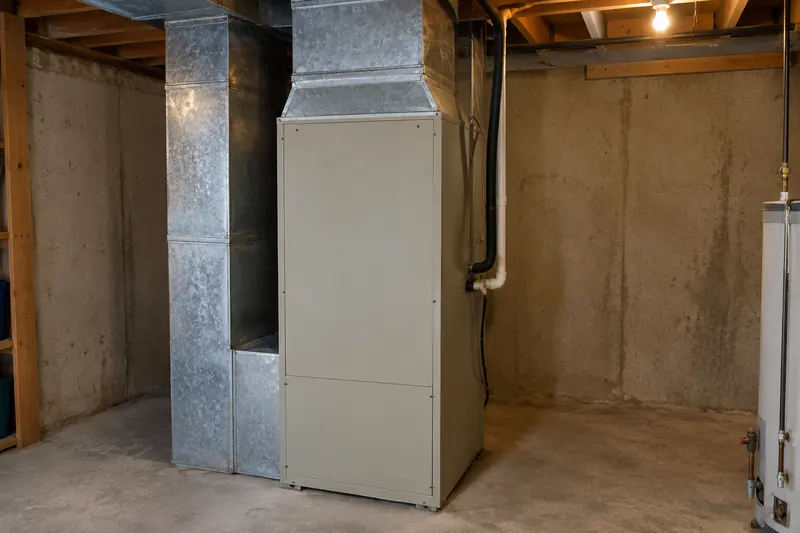
In most all-electric Ohio Valley homes, aux heat is a set of electric resistance coils, called heat strips or a heat kit, inside the indoor air handler. Goodman's explainer lists heat strips as the electric element used for auxiliary heat on cold days or to recover from lower setback temperatures. A supply house's listing of electric heat kits (PlumbingSupplyAndMore, shares owners with Heat Pump Weather) shows what that part looks like; a licensed installer sizes and wires it to the air handler.
In a dual fuel home, the backup is a gas or propane furnace instead, which Honeywell also lists as a common aux source. The dual fuel page covers that setup. Any fuel-burning furnace calls for CO alarms on every floor and outside each sleeping area, with battery or battery backup, interconnected if possible, and a yearly professional inspection (per CPSC) (CPSC); if an alarm sounds, get everyone outside, then call 911. Smell gas? Leave first, get clear of the odor, and only then call 911 and the gas utility or propane supplier from outside or a neighbor's; no switches, matches, phones or sparks on the way out, and no valves or relighting.
What is emergency heat?
Emergency heat is a manual thermostat position that turns the heat pump's compressor off and heats the house with the backup alone. Honeywell's TH4000 operating manual says it plainly: "Compressor is locked out." Honeywell adds that emergency and auxiliary heat are commonly the same equipment, either electric heat strips or fossil fuel.
So the hardware is usually identical; what changes is who is in charge. Aux heat is the thermostat's call, layered on top of the heat pump. Emergency heat is yours, and it removes the heat pump from the job entirely. Lennox's HP29 owner's manual describes it as temporary heat supplied by the auxiliary heat.
| Mode | Who turns it on | Compressor | Heat source | When it fits |
|---|---|---|---|---|
| Heat | You, once for the season | Runs | Heat pump | Normal winter operation |
| Aux heat | The thermostat, automatically | Runs | Heat pump plus strips or furnace | Cold nights, defrost, recovery |
| Emergency heat | You, by hand | Locked out | Strips or furnace only | Outdoor unit out of action, until repaired |
Why does aux heat cost so much more?
Aux heat costs more because electric strips turn each kilowatt-hour into exactly one kilowatt-hour of heat, while a heat pump moves several. A DOE Building America report (2013) treats electric heat as having a COP of 1.0. ENERGY STAR puts a heat pump's output at as much as three times the electrical energy it consumes.
DOE's federal purchasing program, FEMP, says resistance elements are inefficient and their use should be kept to a minimum; BASC calls them an inefficient and typically expensive form of heat. That gap is also why a heat pump often cuts heating electricity by about a third to a half compared with baseboard or an electric furnace (DOE's 2022 Energy Saver Guide estimates about 50%; BASC says 30% or more).
To put prices on it, use cost per million Btu delivered: price per kWh ÷ (3,412 Btu × COP) × 1,000,000. With Kentucky's August 2026 average residential price of 13.80¢/kWh (EIA), strip heat at COP 1.0 works out to about $40 per million Btu. At an example COP of 2.5, which Heat Pump Weather picked for illustration, the heat pump's figure is about $16. Put your own rate from your bill into the same formula.
Aux heat costs more because electric strips turn each kilowatt-hour into exactly one kilowatt-hour of heat, while a heat pump moves several.
When does the thermostat turn aux heat on?
The thermostat calls aux heat in three situations: the heat pump can't keep up, the outdoor coil is defrosting, or the house is recovering from a large setback. Goodman's heat pump FAQ says auxiliary heat kicks on when the heat pump needs more capacity to meet your set temperature. That usually means nights below the balance point, commonly between the upper 20s and low 30s for standard single-speed units.
Defrost is the second trigger. The Lennox EL21KLV instructions say the thermostat may engage aux heat during defrost and the unit returns to normal afterward. The defrost cycle page explains why that happens so often in a Kentucky winter.
Recovery is the third. DOE's 2022 Energy Saver Guide warns against manual setbacks on a heat pump if they bring on backup resistance heat. Some thermostats also stage aux by how far the room is below the setpoint, and installers can add a lockout such as ecobee's "Aux Heat Max Outdoor Temperature." ecobee's threshold article says those settings change only on the thermostat and suggests contacting its support before changing them; ask your installer. The thermostat settings page covers the rest.
When should you switch to emergency heat?
Switch to emergency heat when the outdoor unit can't run, such as a failed compressor or a unit heavily iced over, and only until a contractor fixes it. Goodman's view is that a comfortable house needs no manual switch to emergency heat when the forecast drops under 32°F.
Some makers name other uses. The Lennox HP29 manual, for one model, says that after power has been out for several hours, run emergency heat first and wait out a six-hour compressor crankcase heater warm-up before returning to Heat. That is model-specific; check the manual for your own unit, and see the cold snap plan for outages.
Remember to switch back. Emergency heat left on runs strip heat at a COP of 1.0 around the clock, with the heat pump sitting idle. If you're unsure, call a licensed technician.
Why did my bill jump in January?
January bills jump because January is the coldest month, and cold cuts a heat pump's output just as the house needs the most heat. In NOAA's 1991–2020 normals, January alone carries about 908 of Louisville's 3,936 annual heating degree days, close to a quarter of the year's heating load (NOAA normals, Louisville).
Look for the extra strip heat behind the jump. Check for emergency heat left on, deep overnight setbacks, a dirty filter, or a thermostat showing "Aux" on mild afternoons; any of those can add hours of COP 1.0 heat. Then compare kWh, not dollars, against last January, since rates change: EIA's Kentucky average rose from 13.10¢ in August 2025 to 13.80¢ in August 2026. If aux keeps showing on mild afternoons, ask a contractor to check the system and its settings.
Can you lower a heat pump's balance point?
Yes, by cutting the house's heat loss or by choosing equipment that holds its output in the cold. Air sealing, insulation and moving ducts inside the insulated shell all lower the load line; BASC notes that ducts kept within the thermal boundary avoid the losses that attic ducts suffer.
On the equipment side, BASC says variable-capacity heat pumps can be right-sized for heating and oversized for cooling with less worry about comfort and efficiency. A cold-climate model, rated to keep at least 70% of its 47°F output at 5°F, moves the crossing colder still; the cold-climate models page weighs the case for one in Kentucky.
What you should not do is chase it with thermostat thresholds. BASC's commissioning guidance says backup heat should run only below the balance point, and installers enforce that with settings such as an aux heat maximum outdoor temperature. ecobee's support article on thresholds says these can be changed only on the thermostat itself and advises contacting its support before changing them. Ask your installer. The thermostat settings page covers what a homeowner can safely adjust, and the aux and emergency heat sections above explain what happens below the line.
Loose ends
Smaller questions readers ask about this subject, answered briefly.
Is the balance point the same as the aux heat lockout?
No. The balance point is a physical crossing of house load and heat pump output. An aux heat lockout is an installer setting that blocks backup heat above a chosen outdoor temperature, ideally set with the balance point in mind.
Why does my heat pump need backup on a 35°F night when the balance point is lower?
Defrost cycles often bring on strip heat briefly, and a setpoint raised by several degrees can call for it too. Neither means the balance point has moved.
Is it bad if aux heat runs a lot?
Some aux on the coldest nights and during defrost is normal. Aux running on mild days, or for hours with the outdoor unit idle, points to a setting or equipment problem worth a contractor's look.
Why does my thermostat say "Aux" when it is 40°F outside?
Defrost is the usual reason, since frost forms on the outdoor coil well into the 40s. A big setpoint jump can also trigger it. If it shows constantly on mild days, have the system checked.
Can I turn aux heat off to save money?
Disabling backup is an installer-level change, and without it the house may not stay warm on the coldest nights or during defrost. Ask your installer whether a lockout fits your system.
Does emergency heat hurt the heat pump?
Emergency heat stops the compressor, so it does not wear the outdoor unit. It simply costs more to run, because strip heat has a COP of 1.0.