Spring & fall
Replacing an Old Heat Pump, and Choosing Who Does It
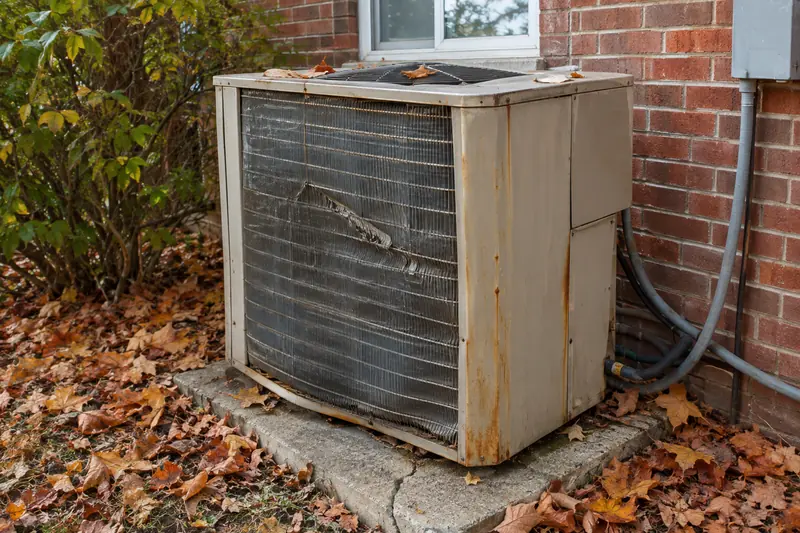
Replacing a heat pump makes sense when it is past about 10 years, needs repeated repairs, or is an R-22 unit facing a major refrigerant repair; the new system usually means a matched indoor coil and a contractor who can show the load calculation.
When is it time to replace a heat pump?
Replacing a heat pump is worth pricing once it passes about 10 years, starts needing frequent repairs, or your bills creep up for no weather reason. Those are ENERGY STAR's three signals, and DOE's 2022 Energy Saver Guide lists the same 10-year mark. Neither agency says to scrap a working unit on its birthday; they say to start comparing.
How long should one last? DOE's federal purchasing program assumes an average life of 15 years in its cost math. Goodman notes that actual life depends on maintenance, filter changes, installation quality, location and hours of use, and in the Ohio Valley a heat pump runs in both seasons: Louisville's 1991–2020 normals carry about 3,936 heating degree days and 1,742 cooling degree days a year (NOAA).
Comfort counts as a signal too. A unit that leans on aux heat every cold morning, short-cycles in July, or leaves rooms clammy may be failing, undersized or oversized. ENERGY STAR says a correctly installed ENERGY STAR unit can save up to 20 percent on heating and cooling costs, which is the upside you weigh against keeping the old one going.
What does the refrigerant change mean for you?
It changes what goes in a new system, not whether the old one can be fixed. Since January 1, 2025, new residential air conditioning and heat pump systems must use refrigerants with a global warming potential of 700 or less, according to EPA's restrictions table. In practice that means R-454B (GWP 470) or R-32 (GWP 675) instead of R-410A (GWP 2,090), using EPA's SNAP listings.
The rule eased in 2026. EPA's May 2026 final rule, effective July 27, 2026, lets R-410A equipment made or imported before January 1, 2025 still be installed, with no cutoff date. EPA also says components used to repair existing systems are not covered by these restrictions, so an R-410A heat pump can still be serviced.
Older units may hold R-22. EPA's HCFC phaseout page shows production and import of HCFC-22 ended in 2020, while servicing existing equipment continues. An R-22 unit that needs a major refrigerant repair is often where replacement talk starts, because no new R-22 is being made.
All of this is technician work. Only EPA Section 608 certified technicians may buy refrigerant for these systems or service them, venting is illegal, and DOE notes that retired units holding HCFCs must have their refrigerant recovered on site by certified technicians. If you're unsure, call a licensed technician.
Why must the indoor and outdoor parts match?
A split heat pump is one machine in two boxes, and its ratings only hold for the combination that was tested together. ENERGY STAR defines a split system as two assemblies joined by refrigerant piping, one with the indoor coil and one with the outdoor coil, and its consumer guide says a good contractor leaves the AHRI certificate showing the rated match.
The refrigerant change made matching stricter. In a June 6, 2025 code interpretation, North Carolina's Office of the State Fire Marshal says that when an R-410A or R-22 outdoor unit is replaced with one using an A2L refrigerant such as R-454B, "the existing A1 air handler or indoor evaporator coil is required to be replaced." It adds that swapping only the coil inside an old cabinet is not an approved method. That is one state's reading of its code, not Kentucky's; ask the installer whether the maker lists the new outdoor unit with your existing coil.
So a "just replace the outdoor unit" quote deserves questions. Ask which indoor coil or air handler it pairs with, and ask for the AHRI certificate number. A supply house's air handler listings (PlumbingSupplyAndMore, shares owners with Heat Pump Weather) show how indoor units are sold by tonnage and refrigerant, which is why the pairing is a contractor's call.
| Refrigerant | Where you see it | EPA GWP | What EPA's rules allow now |
|---|---|---|---|
| R-22 (HCFC-22) | Older units | not an HFC; not in that table | No production or import since 2020; servicing existing equipment continues |
| R-410A | Many units built before the 2025 change | 2,090 | Repairs not restricted; pre-2025 equipment may still be installed |
| R-454B | Many new systems | 470 | Allowed in new equipment designed for it (A2L) |
| R-32 | Many new systems, including mini-splits | 675 | Allowed in new equipment designed for it (A2L) |
A split heat pump is one machine in two boxes, and its ratings only hold for the combination that was tested together.
When does a repair still make sense?
A repair usually makes sense on a younger unit with one clear fault and a decent track record. A failed fan motor or control on a seven-year-old R-410A system is a different decision from a third refrigerant leak on an R-22 unit near 20, and the ENERGY STAR test of "frequent repairs" plus rising bills is the honest dividing line.
Before calling anyone, rule out the simple things. Lennox's homeowner pre-service list says to verify the thermostat setting, check that the disconnect switches are on, look for a tripped breaker and check the filter; the maintenance checkup covers what else stays in homeowner hands. Panels, wiring and refrigerant stay with the technician.
Ask for the diagnosis in writing: the part, the refrigerant type, whether the charge was low and why. Ask whether a leak was located, not just refilled, and whether the coil or line set is the likely source. That paper makes a repair-or-replace comparison possible.
Money tilts the choice in a few cases. Federal tax credits no longer help: under IRS guidance, the 25C credit ended for heat pumps put in service after the last day of 2025. Utility rebates do, and some co-ops pay more for leaving resistance heat or choosing a cold-climate unit; the rebates page lists current amounts.
What should the new system include?
A new system should arrive with a load calculation, a matched and certified indoor-outdoor pair, a heat-pump thermostat and documented startup tests. ENERGY STAR says the contractor should leave the manuals plus sizing calculations, the AHRI certificate and records of measurements or testing. ACCA's Manual J is the recognized load method, and the sizing page explains why the old unit's tonnage is not a plan.
Duct and airflow checks belong in the job. ENERGY STAR's quality installation page asks contractors to inspect ducts, perform a leakage test, set airflow to the maker's specs and test and adjust the refrigerant charge. DOE's purchasing guidance adds a thermostat made for heat pumps, which ramps up slowly to avoid triggering the strip heat.
Think about winter while you shop. A replacement is the moment to weigh a cold-climate model, and the second half of this feature lists what to ask before signing.
Who is allowed to install a heat pump in Kentucky?
In Kentucky, HVAC contracting belongs to the holder of a master heating, ventilation and air conditioning license, who is also the one entitled to obtain the permits, under KRS 198B.656. The same statute says no one may practice HVAC contracting without meeting the licensing law. The Kentucky Department of Housing, Buildings and Construction has a Division of Heating, Ventilation and Air Conditioning that handles it.
Permits come next. KRS 198B.6671 requires a permit before installing an "initial" heating or cooling system, and the permit shows the master license number. Whether a like-for-like replacement needs a state permit is a question for the Department of Housing, Buildings and Construction or your local inspector; ask the contractor which one they will pull. The law also exempts owner-occupants working on their own homes from the licensing sections.
Across the river the rules shift. Ohio's Construction Industry Licensing Board licenses HVAC contractors for commercial projects, and the statute's definition leaves out residential buildings, so check your city or county. Indiana's professional licensing agency lists no HVAC entry among its professions; again, the city or county is the place to ask. Anywhere, the person handling refrigerant must hold EPA Section 608 certification.
Which questions show a careful heat pump contractor bid?
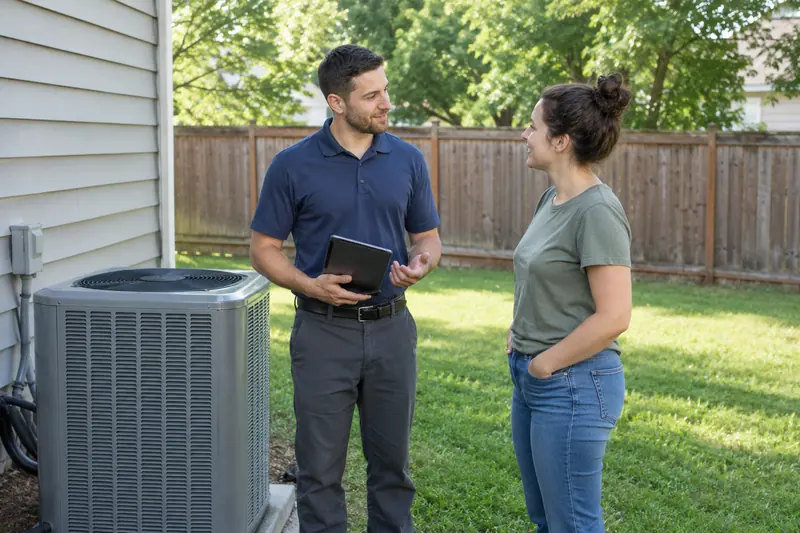
The careful bid is the one that measures the house before naming a size. Ask: "Will you do a Manual J load calculation, and can I have a copy?" ACCA describes Manual J as the national ANSI-recognized standard for sizing loads, required by national building codes and most state and local jurisdictions, and Manual S as the companion method for picking equipment within size limits.
A bid that sizes by square footage alone is a warning. ACCA's code committee names rules of thumb such as "500ft2/ton" among the reasons equipment ends up oversized, and ENERGY STAR tells homeowners not to accept a rule of thumb. The sizing feature explains the inputs and what goes wrong without them.
Then ask about the ducts and the weather. Useful questions:
- Will you inspect the ducts and run a leakage test, and what will you seal?
- How will you set and measure airflow?
- At what outdoor temperature does this unit's output fall off, and is a cold-climate model worth pricing?
- Which rebates does this install qualify for, and will you file the paperwork?
Rebates sometimes decide who can do the work. TVA EnergyRight requires a member of its Quality Contractor Network, Kentucky Power's EnergyAdvantage page says a licensed contractor must install most rebate measures, and Indiana's Energy Saver Program uses qualified contractors and warns that its contractors do not go door-to-door. Details are on the rebates page.
What should the written quote include?
A written quote should name the exact outdoor and indoor model numbers as a matched pair, the AHRI certificate, the refrigerant, the thermostat, the permit and the tests. The ENERGY STAR heating and cooling guide says a good contractor leaves all equipment manuals plus sizing calculations, the AHRI certificate and records of any measurements or testing.
The refrigerant line matters more than it used to. New systems use lower-GWP refrigerants such as R-454B or R-32, and an R-410A indoor coil generally can't stay with one of those outdoor units; the refrigerant section above explains why. Ask whether the quote includes a new coil or air handler and whether the line set is reused.
Warranty terms belong on paper too. The Building America Solution Center notes that some makers require certain installation tests to qualify for extended equipment warranties, so ask which tests the warranty needs and whether registration is the contractor's job or yours.
| Item | Why it matters | Source |
|---|---|---|
| Manual J load calculation | Bases tonnage on measured heat loss and gain | ACCA |
| Manual S equipment selection | Keeps the chosen unit within size limits | ACCA |
| AHRI certificate for the matched pair | Shows the ratings belong to that combination | ENERGY STAR |
| Duct leakage test and repairs | Leaky ducts waste energy and cut airflow | ENERGY STAR |
| Startup test records | Proves charge, airflow and controls were checked | BASC |
How should backup heat be set up?
Backup heat should run only when the heat pump truly can't carry the house: below the balance point, during defrost, or when the outdoor unit has failed. The Building America Solution Center's commissioning guide says the installer should make sure the backup source operates only below the balance point temperature. That matters because electric strip heat has a COP of 1.0, against well above that for the heat pump in mild weather.
Ask how the thermostat stages aux heat. Some thermostats have installer settings that block strip heat above a chosen outdoor temperature; ecobee's support article describes an "Aux Heat Max Outdoor Temperature" threshold and warns owners to contact support before changing thresholds. These are the installer's settings to explain and set, so ask what they chose and why.
Where a gas or propane furnace backs up the heat pump, the dual fuel switchover is set by the installer from the equipment, the house and local fuel and electric prices; there is no standard number. With a fuel-burning furnace in the house, CPSC wants carbon monoxide alarms on every story and outside the sleeping rooms (run on batteries or with a battery backup, and linked together where you can), plus a yearly professional inspection of the heating system (per CPSC). If a CO alarm sounds, get everyone outside, then call 911.
Backup heat should run only when the heat pump truly can't carry the house: below the balance point, during defrost, or when the outdoor unit has failed.
What should happen at startup?
Startup is when the contractor proves the system works as designed, with numbers. For every heat pump, the Building America Solution Center lists a nitrogen pressure test, a vacuum decay test, refrigerant charge verification and controls verification. Ducted systems add total external static pressure, airflow measurement, a duct leakage test and system performance verification.
Ask for the readings, not just a checkmark. ENERGY STAR's quality installation page says poor airflow can bring damp air, higher bills and a shorter equipment life, and that the contractor should test and adjust the refrigerant charge. Refrigerant work is for certified technicians only. If you're unsure, call a licensed technician.
Before the crew leaves, have them show you the filter slot, the condensate drain, the thermostat's heat-pump settings and the outdoor disconnect. The spring and fall checkup picks up from there.
For a sense of how heating companies describe this kind of work, Central Plumbing HVAC's heating service page (Central Plumbing HVAC, shares owners with Heat Pump Weather) is one example; that company works in Bucks and Montgomery County, Pennsylvania, not in the Ohio Valley, so look for a licensed HVAC contractor in your own area.
Loose ends
Smaller questions readers ask about this subject, answered briefly.
Can an R-410A heat pump still be repaired?
Yes. EPA says components used to repair existing systems are not subject to the new refrigerant restrictions. Only Section 608 certified technicians may buy and handle the refrigerant.
Is R-22 refrigerant illegal now?
Production and import ended in 2020, per EPA, but servicing existing R-22 equipment is still allowed. Supply is limited to what already exists, which is why major R-22 repairs prompt replacement talk.
Can a new R-454B outdoor unit use the old indoor coil?
Often not. North Carolina's fire marshal reads its code as requiring the old A1 coil or air handler to be replaced, and EPA's use conditions limit R-454B and R-32 to equipment designed for them; ask the installer whether the maker lists the new outdoor unit with your existing coil. Ask the installer for the AHRI certificate of the pair.
Is an A2L refrigerant safe in a house?
EPA lists R-454B and R-32 as acceptable with use conditions, meaning the equipment is designed, listed and labeled for them. That is part of why a matched, listed system matters.
How many quotes should you get for a heat pump?
No agency sets a number, but more than one quote lets you compare whether each contractor ran a load calculation and named the matched AHRI pair. Compare the scope, not just the total.
Can a handyman install a heat pump in Kentucky?
Kentucky law reserves HVAC contracting to licensed master HVAC contractors, with an exemption for owner-occupants working on their own homes. Anyone handling refrigerant also needs EPA Section 608 certification.
How do you check a Kentucky HVAC license?
Ask for the master license number, which appears on the permit under KRS 198B.6671, and check it with the Department of Housing, Buildings and Construction.